

Warning to the politics of warning: Dismantle the language, scatter the metaphor

Güncelleme tarihi: 16 Eki 2025
The exhibition of Günseli Baki’s research-based art project Hatırlama Defteri is taking place from September 27 to October 26, 2025, at the Odeon Pergamon Culture and Art Center in Bergama. Hatırlama Defteri, featuring works by Günseli Baki, Jenny Berntsson, Selin Atik, Sezgi Abalı, Seçil Yaylalı, and Şerife Aslan, is based on a feminist memory research project conducted through interviews with 40 women from Turkey and abroad. The exhibition will travel to Bayetav Sanat in İzmir in January, to Eldem Sanat Alanı in Eskişehir in March, and will be open for viewing in Istanbul in the fall
Words: Nazlı Pektaş

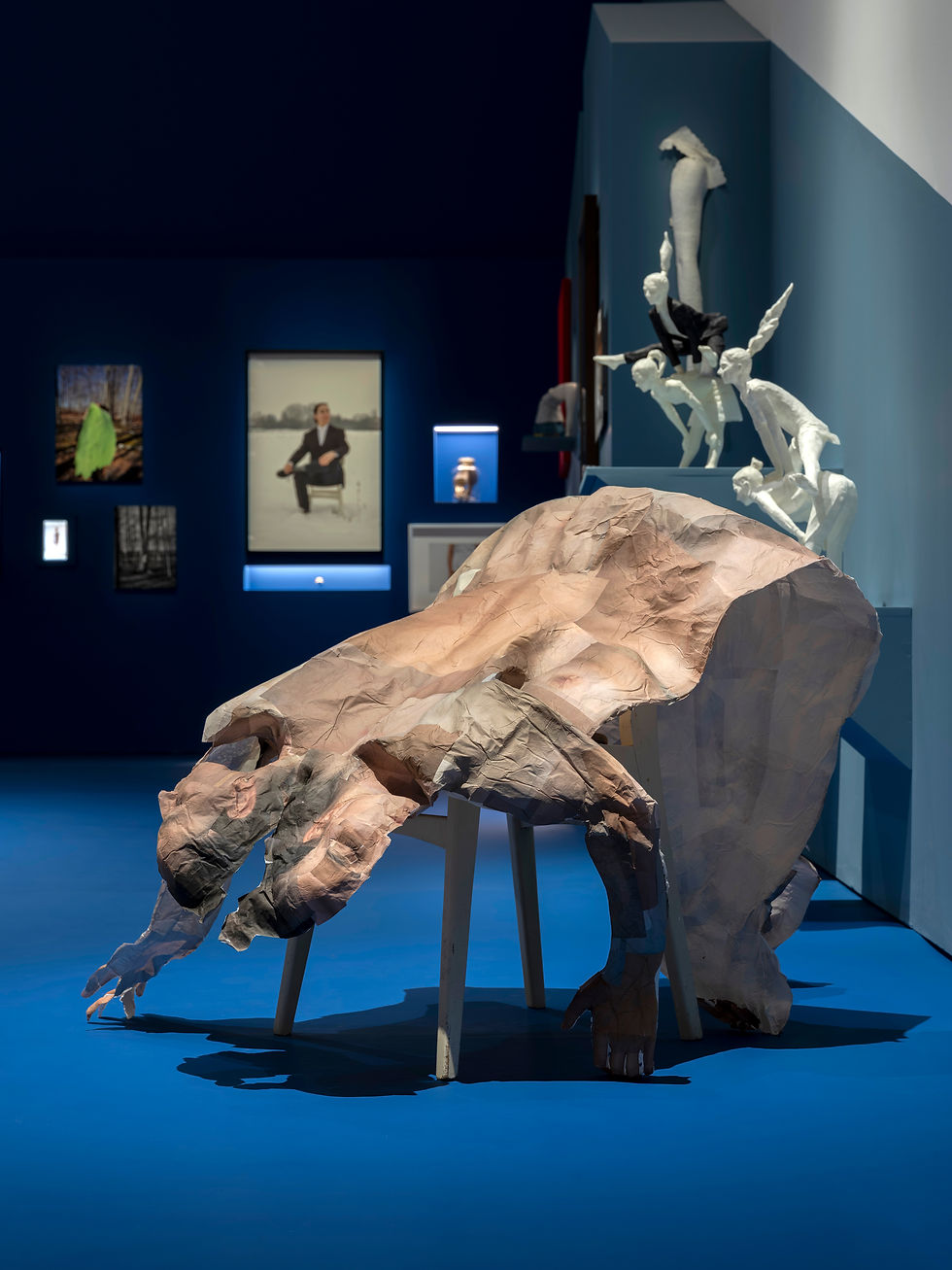
Hatırlama Defteri, View of the exhibition. Photo: Yücel Tunca
The hand first searches through memory. Hatırlama Defteri opens precisely here, with the warnings whispered into the ear in childhood: Close it, shame, cover, lengthen, hide, cut, hush... Over the years, the order inscribed upon the body can no longer fit within the confines of any notebook. At the Odeon Pergamon Cultural and Arts Center in Bergama, these inscriptions stand before us, in the direction of the gaze, in the small suffixes of language, in the invisibility of domestic labor. The exhibition is woven through a series of interviews rooted in women’s own experiences; testimony turns into performance, and performance into the contemporary. The aim is not to amplify trauma, but to calmly expose the micro-mechanisms that internalize it. Instead of grand statements, speaking through methods that work.
One day in middle school, after my science teacher’s endless warnings (for them, my hair had to be either long enough to tie up or short enough to expose my neck) I found myself in the hairdresser chair. At the time, I had hair like Heidi. I still remember the torn brown cape of the hairdresser chair and the salt of my tears. The day I returned to school with boyishly short hair, I realized that the person in the mirror was no longer me. My hair was my identity. For years, my father and I went to Uncle Nevzat, our hairdresser, for the same haircut; every time, my father would say, “You look just like Heidi” Even though he was on the school’s parent–teacher committee, not even my father could stop that teacher, perhaps it was a shared exercise of power. That’s when I first grasped what masculine authority meant, and I paid for it with my hair. That’s why every detail I saw in this exhibition, beyond being an act of remembering or reminding, is a clear lesson on how consent is constructed and how the body is disciplined.
The feminist foundation in the exhibition does not merely declare itself; it manifests materially and methodologically as well. Materials and methods, alongside image and concept, become powerful tools for a feminist reading. Where a button is fastened, whether a seam allowance remains visible, how the weight of a word accumulates across a line, where and how a note is pinned… The chain of interview, transcription, and montage embeds these questions directly into the form of the works themselves: Who has the right to speak? Where does consent begin? What are the limits of representation? In this way, the exhibition insists on a space between two extremes, without falling into the aestheticization of victimhood or the polished slogans of power. As internalized warnings are removed, small gestures take their place. Remembering shifts from being a purely emotional image to serving as infrastructure for self-defense and subject formation.
Hatırlama Defteri, Senin Hatırladıkların display board. Photo: Günseli Baki
At the entrance, a wall greets the viewer: crumpled papers, thrown to the ground and then reattached to the wall. Moreover, they are visible from outside, observing the street. Each visitor, mostly women, leaves behind a warning from their own life, written here. The wall turns lived experiences into a contemporary lexicon. I wrote as well, a few lines drawn from the memory I shared above. While reading the others, I noticed this: many warnings begin with hair — long or short, exposed or covered, tied up or loose. Hair is the earliest site of identity negotiation; this wall, in turn, is the public record of that negotiation.
Left: Günseli Baki, Kendi Kararı. Photo: Günseli Baki Right: Günseli Baki, Giydiğimiz Tüm Gömlekler. Photo: Günseli Baki
Viewed through this record, Günseli Baki’s work Kendi Kararı opens from another perspective. Hair wrapped around the wrist: the surface of an internalized warning. The calmness of the photograph makes visible the body’s reflex to regulate itself, leaving this question: if this is truly my decision, at what age, with whom, and within which lexicon was it established? The answer resides in the material: the tension of each hair strand, the traces of pedagogy that for years repeated the lesson of “gather yourself.” In Baki’s series Giydiğimiz Tüm Gömlekler, the collar line, the spacing of buttons, and the subtle intervention of a finger transform the body into a measuring instrument. How wide it opens, where it fastens... These , beyond being an aesthetic matter, are also the micromechanics of consent. While playing with millimeters, an implicit negotiation takes place: with whom, how much, in what context, at what pace... In her photographs, Baki invites us to consider not the adornments applied to the body, but the tools that measure and adjust it; she reveals the everyday politics the body enacts upon itself.
1-2. Selin Atik, Olumsuzluk Eki. Photo: Günseli Baki 3. Selin Atik, Olumsuzluk İzi. Photo: Günseli Baki
Selin Atik, with her work Olumsuzluk Eki ve Olumsuzluk İzi, measures the weight of language through typography. As the paper darkens, the accumulation of “do”s and “don’t”s ceases to be text and becomes pressure itself. The verbs written one atop another (I couldn’t be, I couldn’t listen, I couldn’t feel, I couldn’t go, I couldn’t say,...) flow like broken breaths. Each negative suffix narrows the subject’s space for action a little more; breath grows shorter. Here, it becomes clear why establishing one’s own voice requires time and effort, for first the suffix must be removed.
Without adopting a didactic tone, Atik points to the prohibition embedded in the matter of the letter; the darkness of the paper carries that intensity. The question arises: Whom does this negation protect, whom does it silence, and how does it operate over which body and in what context?
Sezgi Abalı, Doğum, Video still. Photo: Günseli Baki
In her video Doğum, Sezgi Abalı attends to bodily knowledge in close-up without turning it into a spectacle: the salt on the skin, the wave of muscle, the rhythm of breath. The video circulates the birth sounds of different women within the undulations created by consecutive images; a singular experience becomes linked to a collective vocal network. Here, the question arises: Is this voice mine, or ours? The work gathers knowledge from body and sound. Watching it, one cannot help but ask: As the world makes space for one more body, what layers is it stacking on top?
Seçil Yaylalı, Elinin Hamuruyla. Photo: Günseli Baki
Seçil Yaylalı’s installation Elinin Hamuruyla stands at the center of the space. At first glance, it appears to be a sculpture, but in fact, it is a barricade. Soft materials, stitching, fabric, and loops displace the hardness of a sentence. Across the surface, the words “ÇOK AYIP” (“SO SHAMEFUL”) are written in capital letters; yet this is not the work’s title. Most of the pieces carry references to the body: some folds evoke the vagina, others trace the layers of skin. Is this a game of display? Certainly not. It is an act that reopens the territories long hidden by the economy of shame, using its own material to do so. The barricade interrupts linear progression; the route shifts. In everyday life, that is precisely what shame does: Lowers the gaze, shortens the step, regulates the voice. Yaylalı reverses the move; the barricade now stands against shame. The seams are not concealed, the allowances remain visible; this openness is proof of making. The trace of handiwork persists as evidence that unsettles ownership; the sentence of shame is unstitched, re-sewn, displaced. Its placement at the very center of the exhibition is no coincidence. Standing in the middle, Elinin Hamuruyla invites reflection on the politics of space. Who passes through where; who is stopped; whose body is measured as suitable or not? The installation may also be read as an intervention that reconstructs circulation, gaze, and the moment of decision itself.
Seçil Yaylalı’s work continues this trajectory. Cutting, folding, pinning, sewing... These small movements of the hand are both gestures of care and acts of knowledge production. The fabric passing through the hands forms relationships, regulates emotion, and determines the mode of touch. For this reason, stitching does not create a romantic scene of feeling; it establishes a field of labor whose public value is claimed. In the process of mending some, are we making others disappear? Where is the record of this labor kept? The question emerges from within the works, as tangible as the seam allowance itself.
Left: Şerife Aslan, Bir Hatırlama Eylemi: Bebeklere Giysiler Dikmek. Photo: Günseli Baki Right: Şerife Aslan, Duvara Konuşmak. Photo: Günseli Baki
Şerife Aslan’s video Bir Hatırlama Eylemi: Oyuncak Bebekler İçin Giysiler transforms the domestic labor technique of sewing into a tool for remembrance. The miniature patterns opened, pinned, and stitched for toy dolls quietly lay bare how femininity is taught onto the body. The pattern, internalized as play in childhood, becomes a schema that later defines the range of movement in adulthood. On Aslan’s table, the allowance pressed with an iron, the fold held with a pin, the trace left by scissors all function like pedagogical lines. The video records the rhythm of women’s labor while also establishing this: Changing the pattern does not merely repair the object. It reorganizes the boundaries of identity. When placed alongside Günseli Baki’s button spacing and Seçil Yaylalı’s barricade, the work makes clear this insight: Small techniques of everyday life are the most solid ground for the political.
Jenny Berntsson, Karşıki Dağda Yangın Var!. Photo: Günseli Baki
In Karşıki Dağda Yangın Var!, Jenny Berntsson brings the gendered metaphor embedded in language into focus. When the underwear of young girls or adolescent girls is visible through their clothing, the rhythm repeated by the women in the family rings in the ear: There’s a fire on the mountain! The same sentence, in the same tone, at the same moment. What is this “fire” attributed to; menstruation, sexual impulse, an internal force, or an ambiguous code that seals meaning with shame? The objects constructed with mixed media test and invert this attribution: Can a plastic tube become a pearl? Can an old cloth become a mountain? Can a candy wrapper burn? Language makes something happen when it says “it is”; it neutralizes when it merely says “underwear.” Berntsson’s gesture dismantles the metaphor and leaves this question exposed: whom does it serve, whom does it silence? Because, in that instant, the chorus that forms, there’s a fire!, assumes the authority to regulate a body in the blink of an eye.
The exhibition functions like a vast courtyard revealing the everyday language of the gender regime in Turkey. Education, family law, work life, media... Warnings operate everywhere. Barriers woven with phrases like “This is best,” “This is appropriate,” or “Shameful” are continuously reestablished within daily life. As Hatırlama Defteri makes these repetitions visible through material, gesture, and rhythm, it enacts an effective politics without grandiose statements. Rather than proclaiming large truths, it proposes small interventions: untie the knot, disrupt the pattern, open the collar, clarify the voice. These gestures place a solid bridge between self-defense and subject formation.
The public value of care also becomes clear along this trajectory. As care labor remains invisible, women’s voice in the public sphere is constrained. Gestures such as sewing, knitting, and combing in the exhibition intervene precisely at this point, touching on the distribution of rights and resources; the thick wall between domestic and public spheres thins through the rhythm of repetition. Small, careful techniques and a politics of long breath.
In my view, the theoretical background of the exhibition connects to two influential voices in feminist writing: Carol Gilligan’s relational ethics, which reminds us that voice is formed in contact with others and that care is not an emotional burden but a value that organizes relationships. (1) Catharine A. MacKinnon, who demonstrates that the issue cannot be resolved through individual goodwill and shows how unequal power relations become codified in everyday life. (2) Hatırlama Defteri brings these two threads together in a contemporary artistic language: on one hand, relational ethics operates through bodily techniques and visual rhythms; on the other, small but persistent practices against structural power become a sustainable counter-move.

Hatırlama Defteri, View of the exhibition. Photo: Günseli Baki
The final word should be left to the collective spirit of the exhibition. Reading this exhibition as a display of singular narratives would undoubtedly be mistaken. This exhibition at the Odeon creates a courtyard where thinking together, remembering together, and the gestures of care are politicized. As I leave the exhibition, I recall my courage to displace language, my insistence on not letting my gender be instrumentalized where life meets ethics, and my determination to make the knowledge of care public without separating it from emotion...
The crumpled papers by the door are visible from the window like a diary, and each short sentence left there becomes a new entry in the collective lexicon. I, too, leave these two questions here for you: Which sentence do you find yourself repeating unconsciously? Which warning do you no longer wish to carry upon yourself?
And I keep repeating the words of Audre Lorde, the American writer and women’s rights activist who defines herself as Black, lesbian, mother, poet, and warrior: “Your silence will not protect you.”(3)

Yorumlar