

Publishing as a form of awareness and resistance

Vanilla, Grass, Almond, curated by Huo Rf, brings together artists at Kendi Collection whose practices invite us to rethink the artist's book through materiality, memory, and intervention. We spoke with Joseph Imhauser, one of the participating artists, about independent publishing, the idea of shared authorship, and participatory modes of production
Interview: Merve Akar Akgün
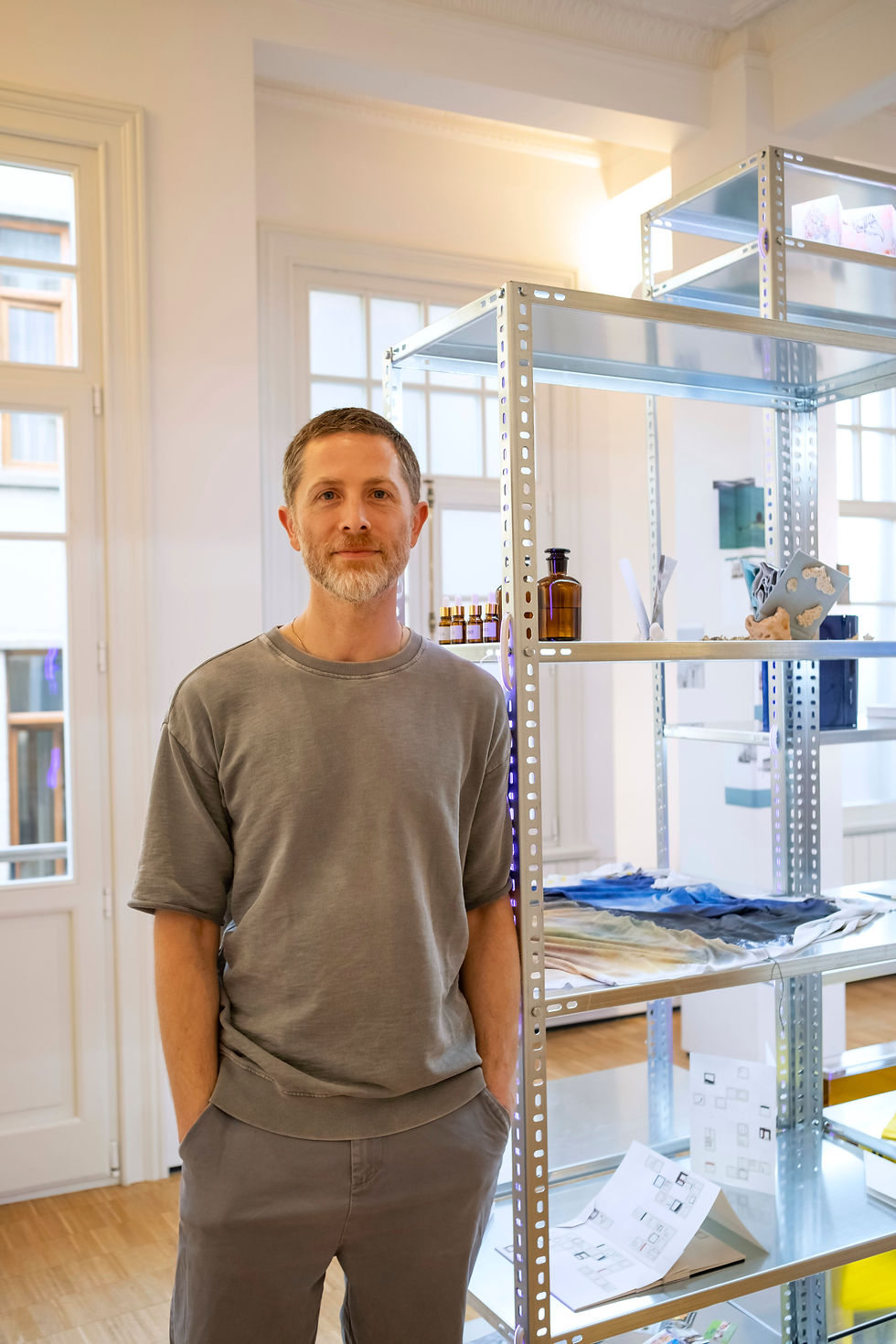
Joseph Imhauser, 2026. Photo: Elif Kahveci
Joseph Imhauser, founder of Lyeberry Press, approaches publishing as a more flexible, interactive, and empowering alternative to conventional exhibition practices, exploring the connective potential of independent publishing. As part of Vanilla, Grass, Almond, curated by Huo Rf and on view at Kendi Collection in Istanbul from 6 April to 28 June 2026, Imhauser presents Solar Systems and Star Maps, a zine that maps the human body, the cosmos, and non-linear time. In this conversation, the artist discusses the publication while also sharing the authorship of the interview itself with its readers, making the boundaries between artist, author, and audience increasingly transparent.
Joseph Imhauser, Solar Systems and Star Maps, Photo: Barış Özçetin
You founded Lyeberry Press in 2017, with a particular focus on artists whose work has not yet been published. Within today's fast-paced and, at times, exclusionary art ecosystem, how do you define or position publishing as an alternative to mainstream exhibition practices?
Publishing represents not only the reclamation of power and the reconstruction of subjectivity, but also the inclusion of a wider range of perspectives. While traditional exhibition formats often function as fixed statements anchored in a particular moment or set of moments, publishing offers a more flexible and open-ended format that can actively shape contemporary discourse. I am fascinated by publishing's capacity to shift, expand, and adapt according to the reader's most intimate realities.
The interactive zine you produced for Vanilla, Grass, Almond allows viewers to touch, transform, and manipulate its images. What does it mean for your practice to challenge the central position of authorship by allowing the work to continually change through audience intervention, rather than imposing its own boundaries?
Much of my work is completed outside of my own actions. I often think of David Medalla's A Stitch in Time, a work that remains perpetually dynamic through conversation, laughter, and even boredom, never settling into a fixed state despite its visual qualities. With this zine, I wanted to explore the idea of shared authority and open up the boundaries between selfhood, sculpture, and community through a process of collective production.
Designed as a publication with neither beginning nor end, the work's open-ended structure also makes its boundaries ambiguous. By rejecting linear progression, how do you think this form reflects both humanity's complex relationship with time and your own embrace of life's uncertainties?
We often imagine time as something that moves along a line, but I think we should instead understand it as a field: a space-time continuum extending in every direction. With Solar Systems and Star Maps, I wanted to communicate this quantum reality. As the large spandex pages are folded and manipulated, each viewer becomes an active participant whose actions shape the experience of the next.

Joseph Imhauser, Solar Systems and Star Maps, Photo: Barış Özçetin
You have said that the images are abstracted fragments of your own body and that you see the human body as a mirror of the universe. How does this relationship between the macrocosm and the microcosm, mapped through your own body, expand your understanding of our place in the world? And what might you say about our ever-expanding connection with the wider universe?
I imagine future beings discovering the images contained within this work and using them to navigate the universe. This unrestricted imagination has the potential to open doors to future definitions and realities. Abstraction plays a role in imagining new forms of collective reality. A world where a hip becomes a solar system and thighs become a star map; a world that situates the self within our collective evolution across space and time. I hope these images function as guides that enable viewers to chart their own journeys without prescribing a destination.
Your practice revolves around the body, porous boundaries, cyclicality, and the unifying potential of independent publishing. In a context like Türkiye, where many viewers and readers may be encountering your work for the first time, how would you describe the shared human impulse at the core of your practice?
Boundaries are defined only for certain periods of time. Borders shift, skin decays, and walls eventually collapse for one reason or another. Publishing is a form of awareness and resilience that enables us to share different perspectives and learn from one another through interaction. I hope my work offers a broad framework for our collective development through poetic reinterpretation, embracing the multipolar and quantum realities that are already part of our everyday experience.


Yorumlar