

Performing Arts Season in Berlin
On rethinking the performing arts as an experience unfolding over time, with Yusuke Hashimoto, director of the Performing Arts Season at Berliner Festspiele
Words & interview: Ayşe Draz

Yusuke Hashimoto
The Berliner Festspiele, which I have written about before in my previous articles on Berlin, is one of those institutions that Berlin tends to take for granted which is also a measure of how deeply it has embedded itself into the city's cultural metabolism. As I have highlighted before, it organizes the Theatertreffen, an annual reckoning with the German-speaking theatre world's most remarkable productions and its main home is, since 2001, the Haus der Berliner Festspiele, opened in 1963 as the Theater der Freien Volksbühne hosting festivals and events that range from MaerzMusik to Tanz im August and to the Performing Arts Season. In 2026 the institution is turning seventy-five, an anniversary it is marking not with nostalgia but with a programme that keeps asking, with some urgency, what a federal cultural institution is actually for in a multipolar, fractured world, and perhaps in a city where the cuts to cultural funding have been a significant topic of discussion. The Berliner Festspiele’s second home is the Gropius Bau near Potsdamer Platz, that has become in recent years more than a venue and more like a proposition; a place where artists don't merely present work but shape the institution itself, where admission-free spaces for children sit alongside large-scale exhibitions and performance works that reimagine what it means to encounter art and each other. The neo-Rennassaince style building, designed by Martin Gropius and Heino Schmieden as a Museum and School of Decorative Arts, opened in 1881, itself carries more history than most institutions would know what to do with. During the Second World War it was badly damaged in air raids, its roof and collections reduced to ashes, and the ruins were left to decay until the building's creator’s great-nephew, Walter Gropius, the Bauhaus founder, campaigned to prevent its planned demolition; it was finally reconstructed and reopened, exactly a century after its original opening, in 1981. Until German reunification in 1990, the building stood directly on the border between East and West Berlin. In 2015, during the Foreign Affairs festival, I encountered Tino Sehgal's constructed situations in the atrium of this same building; only stepping into the museum's grand glass-roofed central courtyard would a visitor realise they had walked into an exhibition at all, as a male and a female performer moved toward each other with choreographic grace, embracing and then kissing in a succession of held poses, becoming, for a suspended moment, living sculpture. This past season I watched Ligia Lewis’s Wayward Chant in this glass atrium which spent nearly thirty years with the Berlin Wall built directly in front of the building's entrance; a history that sits in the walls whether or not the programme acknowledges it. Together, the two venues, Haus der Berliner Festspiele and Gropius Bau host a constellation of festivals; Theatertreffen, MaerzMusik, Musikfest Berlin, the Performing Arts Season, each with its own curatorial logic, its own community of artists and audiences, held within a shared institutional frame celebrating, this year, its seventy-fifth anniversary.
A few weeks ago, we managed to sit down with Yusuke Hashimoto, at Haus der Berliner Festspiele, for an interview at a moment when the cultural calendar was especially charged. MaerzMusik, (which literally means March Music) in which Berlin thinks loudly about what listening means, had just opened with Georg Friedrich Haas's 11,000 Strings where fifty pianos and an ensemble of instruments filled the industrial hall of MaHalla, performed by Klangforum Wien. The acoustic experience in the huge hall of MaHalla, once an electric turbine, with high ceilings and a century of industrial memory in its walls, was something entirely other than a conventional concert hall experience. The concert transformed sound into architecture, music as a renegotiation of the space. In the meantime Meredith Monk, one of the great American artists of her generation whom I heard of more as a choreographer, but apprently is also a great avant-garde pioneering musician, was receiving the Berlin Grand Art Prize at the Academy of Arts across town. Thanks to this encounter I learnt that this 83 years old multidisciplinary artist, a composer, vocalist and performance-maker, was best known for her extended vocal technique, treating the human voice as a complete instrument capable of sounds far beyond conventional singing. Apparently her 1969 Guggenheim piece Juice is considered a foundational work of site-specific performance. I realized that to call her simply a musician or a dancer/choreographer would be to undersell her; she is closer to a one-person genre just like my favorite Laurie Anderson.
Yusuke Hashimoto, born in Fukuoka in 1976, studied aesthetics and art theory at Kyoto University before embarking on his journey in performing arts as an independent producer, patiently building relationships with artists across Japan's theatre and dance scene. In 2010 he founded Kyoto Experiment, the city's first international performing arts festival, applying a logic of decentralisation to a tradition-heavy city. From 2014 on, he also ran ROHM Theatre Kyoto, a municipal institution with a rather more classical repertoire; and as I learn during our interview, he has held both roles in parallel. When Matthias Pees was appointed in 2022 to lead the Berliner Festspiele, he brought Hashimoto on, sensing in him precisely the curatorial sensibility needed for a programme that wanted to think beyond Europe's own reflection. The fact that he is an unlikely figure to be steering one of Europe's most storied cultural institutions is precisely the point. Since 2023, the Performing Arts Season Hashimoto now leads has been bringing international dance, theatre and performance to the Haus der Berliner Festspiele and the Gropius Bau through the autumn and winter months, each edition/season building a distinct conceptual argument with a thematic thread weaving together the various performances featured in the program. The current season, running through January 2026, took identity as its starting point: not as a fixed category but as something fluid, contested and stubbornly shared, with works from William Kentridge, Akram Khan, Eun-Me Ahn, Ligia Lewis, Gisèle Vienne, Thorsten Lensing, and Nina Laisné offering what felt less like a programme than an ongoing, deliberately unresolved conversation.
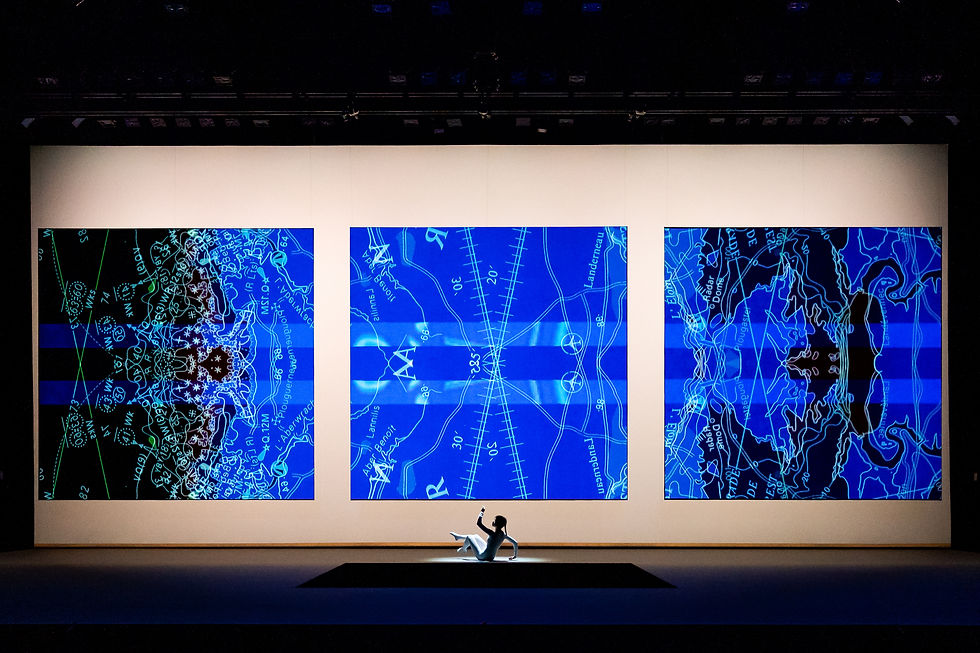
The season's seven productions each staked out their own territory. It opened with William Kentridge's The Great Yes, The Great No was like part theatre play, part oratorio, part chamber opera, refering to a real 1941 sea voyage from Marseille to Martinique with historical phantoms: Frantz Fanon, Frida Kahlo, Aimé Césaire, Joséphine Baker, André Breton, all united by exile, colonialism and the weight of what Europe had become, which resonated uncomfortably with the present. The Great Yes, The Great No was like a Kentridge installation borught to life with its cardboard portrait masks, animated projections, eight languages and a seven-woman chorus that became the emotional centre of the whole piece. Akram Khan, bidding farewell to dance-making after twenty-five years with Thikra: Night of Remembering brought together an all-female international cast of Bharatanatyam and contemporary dancers. They portrayed a ritual journey through ancestral memory and the sacred practices that have shaped and are quietly disappearing from shared human experience. However in comparison to his more sophisticated earlier works, Thikra felt like, in spite of some performers’ impressive performances, in the tradition of a spectacle show. I could not see Eun-Me Ahn's Post-Orientalist Express, in which the Korean choreographer, rooted in shamanic ritual and trained in both Korean tradition and US contemporary dance, dismantles Orientalist clichés. Dominican-born, USA-raised and since 2006 Berlin-base choreographer, director Ligia Lewis’s Wayward Chant in the Gropius Bau atrium was conceived specifically for that space, taking place alongside her video installations in the surrounding rooms. The choreography was presented rather as a political act which interrogated Black experience and the politics of representation, while simultaneously claiming the vast interior courtyard as its own territory. Watching the performers who seemed to me to embody the history of Black slavery across the American continent, unsettled me in a way I couldn't quite name. Gisèle Vienne's Showroomdummies #4, which premiered at ROHM Theatre Kyoto in 2020, traced a journey from Japan to Berlin, a connection that Hashimoto carried from his years at ROHM Theatre Kyoto. In the latest version of the work, which Vienne and Étienne Bideau-Rey have continuously revisited since 2001, six performers were on stage alongside life-size dolls. However its slowed-down choreography in which light, space and sound functioned as a single compositional system probing femininity, power and the uncanny border between presence and absence, was challenging to follow. It beacme too monotonous, catching my attention only by some moments obviously inspired by Japanese horror film aesthetics. For me, the sound score was the most interesting element of it all. In January two world premieres took place in the season, a fact that explicitly showed Hashimoto's curatorial investment in new creation. Independent director Thorsten Lensing's Tanzende Idioten (Dancing Idiots), was a Berliner Festspiele co-production, which despite featuring my beloved Ursina Lardi, was in my view the season’s most conventional and boring production, with nothing interesting in either content or form. At first I thought I did not understand the depth of the story since it was a German production without surtitles in English, however when another prominent German director who is an acquaintance and whose theatrical works which challenge the norms, left the performance during the break, my disappointment found an unexpected accomplice. However the season closed with one of the most inspiring performances I have seen in years, Último Helecho, the collaboration between Nina Laisné, François Chaignaud and Argentine singer Nadia Larcher. The work, drawing on South American folklore genres, wove vocal and physical expression without allowing either to dominate the other, and evoked memory as something alive, reconfigurable, not yet fixed. The performance, where the musician danced, the dancer sang, and the space oscillated between past and future, was imbued with ancient wisdom and had a healing effect on the audience, creating a liminal space amidst the darkness and realities of the present day.
The fourth Performing Arts Season, announced for autumn 2026, suggests Hashimoto is not scaling back either his ambitions or his appetite for the durational and the ritual. Marina Abramović opens proceedings in October with the German stage premiere of Balkan Erotic Epic , her exhibition opening in April at the Gropius Bau. The frame for the season as a whole is myth and ritual, which reads less like a theme and more like a deepening. The confirmed lineup includes Abramović, Mario Banushi returning after his appearance in this year's Performing Exiles, Marie Chouinard, Anne Teresa De Keersmaeker and Rosas with Ictus and Bl!ndman, Dumb Type, Damien Jalet and Kohei Nawa, and Gisèle Vienne, making it the largest and most densely programmed season to date. The full programme will be published in June 2026 but until then here you can read what Hashimoto and I spoke about.
Foreign Affairs festival ended in 2016, and Matthias Pees, the intendant of the Berliner Festspiele brought you in with a new vision that involved a team from different backgrounds. Together with Pees, you structured something different from Foreign Affairs which was a summer festival. Now it's a season, built around a thematic thread. How did you approach inventing something new like this and coming from Kyoto, how did this outsider-insider dynamic shape your vision of structuring this?
Yes. When I came to Berlin together with Matthias Pees, we recognized, there are a lot of festivals bringing international performance productions to Berlin. For instance, the Schaubühne organizes the FIND festival. The Hebbel am Ufer presents Tanz im August and hosts several smaller festivals throughout the season, and Sophiensæle organizes Tanztage. At the same time, however, we noticed that there are not enough opportunities to present large-scale international productions in Berlin. Festivals tend to group different works under a shared curatorial theme, creating a strong overall framework that attracts audiences as a cohesive program.
But if I may say so, I don’t necessarily see the festival format as ideal for fully appreciating a single work. It can be difficult to engage deeply with one production – to truly understand its context, its background, and the ideas behind it – when it is presented alongside many others in a condensed timeframe.
For this reason, we decided to establish the framework not as a festival, but the season in which the audience focuses on one single production to appreciate just not only the time of the performance but also the “before the performance” to learn about the background and also the “after the show” to talk with colleagues or friends. In this way, we aim to offer audiences more time, a deeper experience, and a broader opportunity for engagement.
Left: Dancing Idiots© Armin Smailovic
Right: Club Amour, Café Müller, Tanztheater Wuppertal © Oliver Look
This reminds me of the Festival d'Automne in Paris; when a program is spread over a longer period, it gives the audience more time to absorb and reflect on each work.Right. And also, we thought, on the other hand, our season does not run the entire year. It takes place only between October and January. Usually, we are bringing limited numbers of productions, between 7 to 8, for four months. This means that we cannot offer a comprehensive program in the way that traditional theatres, with year-round programming, are able to do. If we had the whole year, we could have more than twenty or thirty productions. So, in that sense, we decided that we should not make the program randomly, but more thematically so that we can present our season as a consistent program.
When you have a limited time, you need a thread to weave the whole program together.
Yeah. So, since the beginning, we try to put the specific theme connecting with each production as one thread.
The first season focused on the body, then memory, with a focus on New York, where performance art and other disciplines merged into new territories. And then last year, identity. I see very clearly an overall thread, and that you keep returning to what connects us, that places the living body and collective memory in the center. And I think this is the strength of what performance can do in comparison to other mediums. You focus next season on myths and rituals. So, I again interpret it as returning to the same theme, but making it even deeper, going more in depth. What we collectively carry, what we inherit. You studied aesthetics, Bigaku in Japanese, which sits at the intersection of philosophy and art theory. Could you tell me how this background of yours played a role in shaping a long-time thread with an essence.
One of the reasons I started to study about aesthetic comes from my first experience of performing arts. My first encounter with contemporary performing arts was a Butoh dance performance when I was a teenager. Sankai Juku. Have you heard of this?
Yes. They came to Istanbul with Utsushi.
I had never experienced something like that. Until then, I believed that people involved in the performing arts were usually born into established cultural families, so I assumed it was not my business. But once I encountered that kind of avant-garde, contemporary dance, my assumption completely changed. Actually, because I was so impressed by the performance of Sankai Juku, I bought a book about them. I learned about their history and artistic development, and I also studied their chronology in detail. Visually, I was impressed by the page in which their chronological history was written. I'm not sure which year, but they found a company in 1975 or something. In the beginning, they presented their first work only in Tokyo – just one city listed for that year. In the second year they started a national tour. Then they performed in Tokyo, Osaka, Kyoto, etc. In 1980, it was the first European tour for them. They performed only in Paris. But right after that, they started the next European tour to Nancy and Avignon, etc. As the years went by, they expanded the number of destinations on their tours nationally and internationally. So visually, looking at the page of their chronology, I found it is like a triangle with the character string. That visual inspired me, because it gave me an idea that the character string presenting the cities is illustrating a trace how they have been expanding their horizon in the real world. What moved me most was the realization that they had opened those doors themselves. Until then, I had been focused on my place within systems defined by others – such as school rankings and existing structures. But in the world of contemporary art and performance, I began to understand that you can define your own values, your own sense of beauty, and create your own path. You can open doors for yourself.
From that moment on, I set my goal: to explore new visions and new measures – to experience the world on my own terms, rather than through existing standards. So since then, I have consistently been worked with artists who seek to create new values. So, when I had the opportunity to establish an international performing arts festival in Kyoto in 2010, I had no hesitation in choosing its title: Kyoto Experiment.
Left: Aerocircus – A Play by Thomas Köck, RambaZamba © Phillip Zwanzig
Right: Dancing Idiots© Armin Smailovic
With the Kyoto Experiment, I read that you refused a single center. It was all around in different venues, using many different spaces. But after Kyoto Experiment, from this decentralized, more challenging approach, you were at ROHM Theater Kyoto.
Yes. In parallel, I was working in both. While developing Kyoto Experiment, I was constantly facing the challenge of sustaining the festival on an institutional level. One day I realized that the city of Kyoto decided to renovate an old theater building, and then I proposed them to work there, and also to combine the organization between the theater, what is now known as ROHM Theatre Kyoto, and Kyoto Experiment allowing me to strengthen the institutional foundation of the festival in 2016.
So how did working for both shape each other?
I believe the program of the theater as a building should be conceived in a “vertical way”; by this I mean that the theatre must engage with history. In my understanding, history can be seen as vertical, because a theatre building exists beyond the lifespan of any single person - it connects past, present, and future. Therefore, when I program international productions within the framework of a theatre’s annual season, I always consider how a work relates to the legacy of the performing arts, or how it might resonate with future generations and younger audiences. In this sense, each production should either connect to what has come before or open possibilities for what is yet to come.
On the other hand, a festival – especially an international one – should be approached in a more “horizontal” way. A festival brings together works from different parts of the world, allowing us to understand what is happening now across various geographical and cultural contexts. This global spread is what I describe as horizontal. When I conceive the idea of the program for the festival, I try to find some current social issues connecting to each production, to make the audience know what's going on in our society, what's going on in the world.
As you answer, I see that you think very visually, you speak in images. Your seasons offer a program with interdisciplinary works. This season you hosted Kentridge, for the next season you have Abramović, Dumb Type. How would you say this plays a role in your curatorial approach?
I recognize that one of the essential qualities of the performing arts lies in collective activity. Even when shaping the theme of a program or a season, I try to keep this quality at the center of my thinking. Collectiveness is, for me, a fundamental essence of the art form.In pursuing this essence, I naturally find myself drawn to multidisciplinary artistic practices. Productions that emerge from dialogue across different disciplines consistently attract and inspire me.
You’ve already answered one of the questions I was going to ask, not the function, not the mission, but the essence of performance in your opinion. And I understand it is collectiveness for you. Yes. Collectiveness makes us recognize a new vision. And also, because each single person has a different perspective and different opinions. Even though each production has one single director, the reality in the process of producing is combining, inviting different elements naturally.When I look back at the history of the performing arts, I see that something truly new often emerges through experimentation – especially through multidisciplinary practices. This is one of the reasons why I am so fascinated by American postmodern dance, which we chose to focus on in the Performing Arts Season 2024/25.
Many of these artists began their careers in the late 1960s, a very particular moment in time. It was an era when traditional disciplines mattered less, and boundaries between forms became more fluid. Artists from different backgrounds came together—often out of necessity, as they lacked financial resources – and shared their ideas through dialogue and collaboration. Out of these encounters, something entirely new emerged.
Left: Post Orientalist Express, Eun-Me Ahn, 2025© Jean-Marie Chabot
Right: Showroomdummies #4 © Yuki Moriya
I mean, the American '60s were in once-in-a-lifetime happening, nobody really cared then but now, we're in such a compartmentalized and I guess politically polarized society. I think it's an important stance to say, “Just come together and experiment.”
Moving on to my next question, I would like to ask this; Berlin recently had huge funding cuts in the culture and arts sector. For the independent scene and, the small stages, the risk takers, of course, this is a huge problem. But as a part of a federal institution, how, what, did it affect you?
Luckily, we haven't been affected yet.. We'll see what the future holds. For the Performing Arts Season, since the second year, we have received a kind support from the private sectors already. For example, one of our partners is Van Cleef & Arpels, a French jewelry company. They have also initiated their own dance festivals in New York and different cities around the world, which show that they understand both the field of contemporary dance and the kind of work we are doing here. Recently, there was also a discussion at the Neue Nationalgalerie addressing this issue. The event, titled “Culture Discourse: The Value of Culture – Financing the Arts in Times of Competing Priorities,” was initiated by the Volkswagen Group, which has been supporting the “Art4All” program at the museum. The discussion highlighted a broader challenge: as public funding for the arts is reduced, the cultural sector increasingly needs to seek support from private sources. In Germany, however, I feel that there is still some hesitation toward engaging with private funding in the arts. It is not yet a widely embraced mindset. Personally, I would like to encourage a more open approach – not only toward companies and foundations, but also toward individual supporters.
From my experience in Japan, I have worked with both public and private funding. Of course, there can be challenges and even negative aspects when working with private sponsors. But at the same time, having a diverse range of supporters expands the network of stakeholders in the arts. It allows performing arts to connect with society in broader and deeper ways.
So, while it is unfortunate that governmental support for the arts in Germany is decreasing, I also see this as an opportunity. It could become a moment to expand our base of support – not only financially, but also in terms of engagement and shared responsibility within society – by inviting individuals and private partners to become more involved.
In Turkey there is a considerable private sector interest in contemporary art, and only in recent years has that interest extended significantly to theater. What about in Germany? Is the private sector interested in valuing the performing arts equally as they would contemporary art? Because they are also very different markets. Contemporary art is buyable and sellable.
Yeah. If I explain the value of the performing arts to the private sectors, I would emphasize, performing arts is a very precious art form because it's not tangible. And the performing arts exists only in the time people gather at the same space.
Ephemeral.
Right. And I also emphasize the performing arts has power to connect people. Because Performing Arts only exists when people gather. So why not? I believe this is an especially important moment to create opportunities for people to come together - encounter one another, and to foster dialogue.
Dumb Type
You've programmed Kyoto-based interdisciplinary collective Dumb Type for the upcoming season. They will present a work about AI, surveillance, the body caught between technology and the living. We are living through a moment where AI dominates every conversation. Could you tell us a bit more about their work.
Yes. The company Dumb Type has been a collective from the very beginning, without a single designated leader. So, the process of the creation is a dialogue, communication itself. So, whatever they create the question of communication inevitably becomes a central theme in their work. Also, each single member of Dumb Type is a specialist of some new technology. In the process of their creation… always they experiment… how the new technology makes our communication better or worse. So then naturally, those kinds of topics, which you mentioned come into that production 2020.
I would like to ask you one last question; what does performing arts needs right now? Not from audiences, not from institutions, but from the people who make it.
One idea comes from my experiences working in Europe. Compared with the other regions outside of Europe, especially here in Berlin or Paris or London or others, the system of performing arts is so established. Theatre and festival institutions can be highly functional, but sometimes they are also overly “established”. The established system may make people divided, focusing on each of their single expertise. Of course, I can appreciate that kind of power of individuality. But on the other hand, I think, sometimes, the productions created in that kind of established mechanism makes the production just a reproduct in the same way while changing just the theme or superficial expression. But substantially, nothing changed. But my essential desire while watching and experiencing performing arts is an unpredictable experience... which is something new. Such innovations often emerge from the “gaps” that exist outside established systems. So, I would like to encourage the artists who are working in the performing arts to start, try to start something from zero. In other words, rather than working backward from an established scheme or framework, they can develop concrete expressions through dialogue in a bottom-up approach. But also, I understand this kind of practice is quite risky. So, I understand the role of a curator or a producer for performing arts that I’m doing is how I or we can create a safe space for the artists so that they can start from the zero point.
Although I answered your question in an ideal way, in reality I often find myself establishing frameworks—and sometimes, regrettably, even pushing artists to work within them. As a professional, I want to get to realize as much as possible because we are working in the real world. We have to start the communication work, and also, we have to sell the tickets. Of course, we cannot ignore that kind of practical things. Because these works are essential for bringing performing arts productions to life. Without “presentation”, a performing arts production simply does not exist. So, it is my contradictory feeling. It is my challenge as well. But as much as possible, I try, and when I communicate with the artist or encourage the artist to create a new piece, try not to prioritize this kind of practical mechanism. So, once we emphasize too much this kind of institutional practical mechanism, the imagination of the artist becomes more narrow-... smaller. Because they start to conceive their idea from the structure. I would like the artists to think the idea from without any framework.
I understand, you're acting as a kind of mediator, you're able to fit the artwork into a framework. But the artist shouldn't be working within that framework. You're already placing the artwork and presenting it within that framework as a mediator. Thank you very much, Yusuke.


Yorumlar