

Impressions from Berlin stages
Our performing arts editor and writer Ayşe Draz shares her observations on the dynamic cultural landscape of Berlin, her home in recent years, and on the performances she encounters across the city’s stages
Words: Ayşe Draz
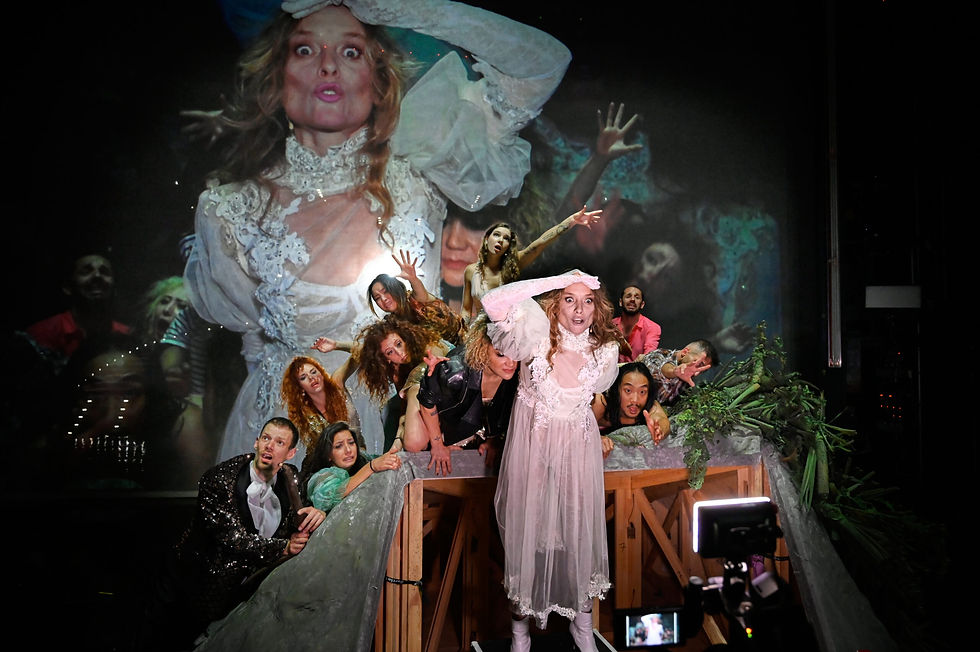
The Hunger, directed and choreographed by Constanza Macras. Photo: Thomas Aurin
Having moved to Berlin at the end of last July, I’ve finally started to think of it as my second home, while continuing to work within and follow the performing arts scene in Istanbul. The fact that I’ve begun creating work here in Germany and closely engaging with Berlin’s performing arts scene are the two main factors that made this transition possible. So far, I’ve only managed to see a few of the performances I had hoped to watch, but before sharing my impressions of them, I’d like to start by reflecting on my second home, Berlin itself.
Multicultural and a poor but sexy city (or is it?)
I remember reading an article in The New York Times¹, if I’m not mistaken, sometime in the early 2000s, that questioned just how “multikulti”² Berlin, the city that proudly presents itself as Germany’s most international and tolerant metropolis, really was. The piece noted that despite major interruptions such as the Second World War, Berlin had long attracted immigrants, and that groups like the French Huguenots and Jews, who sought refuge here in the 17th century, had significantly shaped the city’s economic, scientific, and cultural fabric. It also cited a 2001 study showing that 42 percent of the 132,000 Turks living in Berlin at the time, most concentrated in Kreuzberg and Neukölln, were unemployed, while other large ethnic groups, such as Russian, Greek, and Yugoslav immigrants, largely confined to particular restaurants and specific neighborhoods. Yet, the article observed that third-generation Turks were beginning to break away from this isolation, becoming more visible in business and in the worlds of culture and art, particularly in music. In the two decades since, both Germany and the world on a global scale have undergone profound political, economic, social, moral, scientific technological, cultural and artistic shifts. Yet my feelings about whether Berlin is truly "multicultural" or not , remain more or less where the article left them.

Today, part of the Turkish-origin communities living in Berlin consist of a new wave of educated and urban immigrants who came to Berlin after the 2010s, especially for economic and political reasons, or because they were worried about their children’s future, especially daughters, like in our case. This has created a mosaic of Turkish-origin groups with different profiles, each ‘integrated’ into the city’s multicultural structure, not in a more positive or negative way than the other, but simply in different ways. Today, the stories of Turkish Gastarbeiter in Germany are being explored through multi-layered and multifaceted perspectives; as in the novel The Golden Horn Bridge by Emine Sevgi Özdamar, who having won many literary award is considered one of the most important names in contemporary German literature, and despite being Turkish, writes her novels in German (and who orgiginally started her artistic career in theatre); or in Cem Kaya’s documentary Love, Mark and Death³. The ethnic groups that today make up Berlin’s ‘multi’cultural fabric differ from those of twenty years ago; both in their composition and in the reasons of their coming to and immigrating to this city.
Refugees fleeing the ongoing wars across the globe, that might well be described as “proxy wars of the great powers”⁴, particularly in the Middle East and Africa; Europeans escaping the democratic backsliding and the authoritarian turn of Eastern Europe and the Balkans in search of a relatively freer Germany; Ukrainians displaced by the Russia-Ukraine war; and migrants forced to leave their countries rendered uninhabitable by the climate crisis; all contribute to the city’s changing texture. Since moving to Berlin, seeing people of so many different backgrounds together, regardless of their reasons for coming, and observing a much more permeable, if not always harmonious, flow between neighborhoods of distinct characters (perhaps it’s inevitable that I keep comparing everything to Istanbul), gives me the impression that Berlin is indeed a geniunely “multikulti” city. Although I still use the term ‘multikulti’ to describe Berlin, which some people dismiss as outdated, I do that with a sharper awareness of the irony it carries. Time has unfortunately shown us how concepts such as ‘political correctness’ or ‘multiculturalism’ can be hypocritically instrumentalized by prevailing political, economic, cultural and technological hegemonies to reinforce their own positions. At the same time we have experienced the cultural and conservative right has been able to transform “multiculturalism”, its supposed opposite into a rhetoric that sustains its own discourse. I continue to use the term today with this double awareness.
Perhaps because I constantly compare it to Istanbul, with its soaring inflation and yet its relentless consumerist frenzy, Berlin still feels ‘poor’ to me, and maybe, as someone still relatively new to the city, the variety of artistic activities I can access here, both in terms of time (thanks to public transport and the city’s pace) and affordability, still makes it ‘sexy.’ But considering Aydemir’s well-founded argument, I too can’t help but wonder how much longer Berlin will remain “poor but sexy” for me.
A few months ago, I read an article by Fatma Aydemir⁵, the Berlin-based German author and journalist whose plays have also been staged at the Gorki Theater, one of Berlin’s prominent theatres addressing the immigrant experience, the cultural, identity and integration issues of migrant communities, and particularly the complexities of Turkish-German identity. I had only recently become familiar with her work through her pieces published occasionally in The Guardian. In her article, Aydemir recalls how former mayor Klaus Wowereit once described Berlin as “poor but sexy.” She notes that in 2003, amid the post-Cold War cultural boom, Berlin, though burdened by debt, continued to attract young creatives from around the world thanks to its low living costs and vibrant arts scene. However, she points out that the €130 million cut planned for the city’s 2025 cultural budget has understandably sparked great concern across the arts community. Indeed, nearly all of my Berlin-based artist friends have taken part in the frequent protests held over the past few months. According to Aydemir, many art institutions and artists that depend on public funding, especially the independent art collectives and small theatres that generate the city’s cultural vitality, now face the threat of bankruptcy. She adds that while conservative politicians argue that the arts should operate according to market principles, such an approach would gravely damage critical and inclusive cultural projects. Aydemir concludes by observing that Berlin, whose identity has long rested on its openness to cultural freedom and originality, is now at risk; it is no longer as ‘poor’ as it once was, nor as alluring. Perhaps because I constantly compare it to Istanbul, with its soaring inflation and yet its relentless consumerist frenzy, Berlin still feels ‘poor’ to me, and maybe, as someone still relatively new to the city, the variety of artistic activities I can access here, both in terms of time (thanks to public transport and the city’s pace) and affordability, still makes it ‘sexy.’ But considering Aydemir’s well-founded argument, I too can’t help but wonder how much longer Berlin will remain “poor but sexy” for me.

The Hunger, directed and choreographed by Constanza Macras. Photo: Thomas Aurin
Volksbühne and impressions from its stage
When deciding what to watch in Berlin, the first venues whose programs I explore are Radialsystem, HAU, and the Volksbühne, one of the city’s most iconic theatres, located on Rosa-Luxemburg-Platz and founded in the late 1890s under the motto “art for the people.” The current building, designed by Oskar Kaufmann in 1914, became a pioneer of experimental and political theatre during the Weimar Republic. In 1933, it was taken over by the Nazi regime and used for propaganda purposes, suffering heavy damage during the Second World War. After the war, situated in East Berlin, it came under the control of the GDR and was shaped by a socialist understanding of art. Following the fall of the Berlin Wall in 1990, the Volksbühne entered a new era when Frank Castorf became artistic director in 1992, transforming it into one of Europe’s most radical stages.
Through Castorf’s daring stagings and his emphasis on politically charged, experimental work, the Volksbühne became not merely a theatre but an intellectual arena in Berlin. When Castorf left in 2017, however, the institution plunged into a period of crisis. His successor, former Tate Modern director Chris Dercon, faced fierce criticism and protests for focusing on international productions, which many saw as a betrayal of the theatre’s political roots and Berlin’s distinctive cultural identity. At one point, activists protesting Dercon even left excrement at his office door as a final act of defiance. Dercon’s successor, Klaus Dörr, soon resigned following accusations of sexual harassment. When René Pollesch took over, he revitalized the Volksbühne by embracing Castorf’s legacy and collaborating with innovative artists such as Florentina Holzinger, drawing a wide audience back to the theatre. Yet Pollesch’s sudden death in February 2024 once again left the Volksbühne in turmoil. This time, however, the crisis was resolved quickly: it was announced that Matthias Lilienthal, who had previously worked at the Volksbühne as a dramaturg under Castorf and later served as artistic director of HAU, would take the helm in 2026. Known for his experimental, interdisciplinary, and participatory approach, Lilienthal has stated that he plans to expand the theatre’s focus on dance by consulting choreographers such as Florentina Holzinger and Marlene Monteiro Freitas, and to give greater visibility to international directors, a plan he described as a “conscious act of resistance” against the rise of nationalism in Germany.

The Hunger, directed and choreographed by Constanza Macras. Photo: Thomas Aurin
I opened my season at the Volksbühne with The Hunger, a piece by Argentine-born choreographer and director Constanza Macras whose work I was seeing live for the first time. Inspired by The Witness, a novel by Argentine writer Juan José Saer, the performance unfolds in the early 16th century in the Rio de la Plata region of South America. Through a sequence of fragmented and dynamic tableaux, it tells the story of a Spanish colonizer who survives an Indigenous attack and joins a native tribe. Staged in what I would describe as a ‘kitsch’ aesthetic, Macras’s The Hunger moves fluidly between past and present, infused with absurd humor. I must admit I thoroughly enjoyed the performance. As the program notes suggest, in The Hunger “cannibalistic rituals overlap with different forms of greed, from colonialism and consumption frenzy in today’s capitalist societies to the hyperproduction of an endless Now on social media.” The performers, all highly skilled and theatrically adept (including Candaş Baş, whose presence I greatly miss on Istanbul stages and who has long since settled in Berlin), execute this vision brilliantly. Still, despite its vivid imagery, I can’t say the piece leaves a truly critical aftertaste, at least not in the way its brochure promises. Perhaps because I leave the theatre feeling full and satisfied, this prompts me to wonder whether such criticality is always a necessity.
The Work, a collaborative production by Susanne Kennedy and Markus Selg. Photos: Moritz Haase
Another work I saw at the Volksbühne was The Work, a collaboration between director Susanne Kennedy whose productions I had followed but never experienced live, and media artist and stage designer Markus Selg. Kennedy is known for her use of new media and technology on stage, her performers’ masked faces, and digitally manipulated, mechanical voices that create a sense of estrangement. Her works often interrogate identity and the body. The Work opens as a talk show in which Xenia, an artist who we later realize is on her deathbed, reflects ironically on art and life while the audience becomes part of the show. As the piece progresses, Xenia continues to create art, audition performers, and revisit scenes from her memories in the moments before her death. Eventually, the stage itself transforms into a vast installation. The audience is invited to move freely among the masked performers who reenact fragments of Xenia’s life. The narrative within the installation is highly fragmented, very difficult to follow or to assemble into a coherent whole, and nearly impossible to translate into a specific emotion. Yet the staging ideas, the positioning of the audience, and the tension created by the interplay of masks and voice keep us engaged in the experience of wandering through it. While drifting through the space, I often found my gaze drawn to one of the spectators: Meg Stuart, the American choreographer based in Berlin, whose work I once admired deeply. Perhaps this is where, for me, much of Berlin’s allure lies, in these chance encounters that fold seamlessly into the fabric of its artistic life.
The Garden of Earthly Delights, directed by Philippe Quesne. Photos: © Martin Argyroglo
Berliner Festspiele and Philippe Quesne’s Garden
Another of Berlin’s “sexy” institutions is the Berliner Festspiele, founded in 1951 and renowned for its art festivals and performing arts events. Bringing together both international and avant-garde artists, the Berliner Festspiele hosts innovative projects across contemporary theatre, dance, music, and visual arts. Among its best-known events is Theatertreffen⁶, which each year gathers the most remarkable theatre productions from German-speaking countries. In addition, the Berliner Festspiele presents MaerzMusik, the Contemporary Music Festival, as well as interdisciplinary performances such as Immersion. Outside of Theatertreffen, its Performing Arts Season, running from October to January, features an impressive, largely international selection spanning both dance and theatre. This season, I attended The Garden of Earthly Delights by French director and stage designer Philippe Quesne, a production I had first seen in 2023 at the Avignon Festival performed in Carrière de Boulbon, an impressive open-air theatre located within a former stone quarry. Inspired by Hieronymus Bosch’s famous triptych of the same name, Quesne’s work unfolds within a dreamlike world populated by his signature cast of peculiar, endearing characters, so much so that I find myself thinking of him as the David Lynch of theatre. Like its original source of inspiration, Quesne’s garden explores the relationship between humanity and nature, a world where culture and nature blur into one another. Yet, it does so with a Lynchian⁷, sci-fi flavor, revealing with dark humor and striking aesthetics our lost, pitiful state as creatures adrift in the deserts of nature and outer space, while simultaneously parodying the spiritual clichés of American New Agers. Through his Vivarium Studio ensemble whose work focuses on the concept of ecosystems, Quesne once again impressed me with the ensemble’s quality of movement, acting, and inventive use of sound and instruments. Rather than presenting a straightforward or fixed narrative, The Garden of Earthly Delights offers a fluid, easily engaging flow in which moments, sound design, and music take center stage within a series of interconnected tableaux. Watching it indoors proved just as captivating as it had been under the open sky.

Minus 16, choreographed by Ohad Naharin. Photo: Admill Kuyler
Staatsballett Berlin with Naharin and Eyal
My next stop was the Staatsballett Berlin, almost a temple for dance lovers, where I went to watch dance and ended up seeing works by both Sharon Eyal and Ohad Naharin on the same evening. Naharin’s Minus 16, a piece that if I’m not mistaken I was watching for the third time, twice by the same company (NDT), and which could be described as the physical embodiment of his Gaga method’s vibrant and ecstatic energy, performed this time by the Staatsballett dancers, with their near-flawless technique and superhuman precision, was especially impressive.

SAABA, choreographed by Sharon Eyal. Photo: Admill Kuyler
Sharon Eyal’s SAABA, set to a composition by Ori Lichtik that this time incorporated elements of pop music into the sound design, carried, as always, that unmistakable hypnotic power. One detail I initially found charming, even “sexy,” but later reconsidered after discussing it with my dear friends Kerem Özel and choreographer Gizem Bilgen, both of whom follow dance closely and whose opinions I deeply trust, was the sight of Staatsballett Berlin dancers signing programs and company brochures in the foyer between the two shows. Did I get mine signed? Yes, I did. But I must have sensed the same discomfort, because I ended up handing my brochure to my husband to have it signed, telling him that I was too embarrassed to do it myself.

Messiah at Tempelhof Airport
Although I’ve seen and continue to see many other works in between, one I can’t go without mentioning is Messiah by the Komische Oper, which I watched in a former airplane hangar transformed into a stage at Tempelhof Airport. I must first admit that I was surprised to discover how much the Komische Oper engages with Turkish culture, using Turkish actively in its promotional materials to attract Berliners of Turkish descent, and developing special projects such as Selam Opera!⁸, Komşu Dolmuş⁹, and Üçüncü Mevki¹⁰. Just last week, Turkish artist Gaye Su Akyol premiered her pop-psychedelic opera Consistent Fantasy is Reality (İstikrarlı Hayal Hakikattir) at the Komische Oper. What struck me most about Handel’s Messiah as performed by the Komische Oper was the sheer joy of watching a 350-member choir made up largely of amateur singers from Berlin’s community choirs, on that vast stage inside the repurposed hangar, their individuality and diversity forming part of the work’s power. The staging and costumes were simple yet vividly colorful, amplifying the production’s sense of warmth and inclusivity. Although I found it difficult at times to follow the narrative of the adaptation, I admired the boldness of transforming Handel’s oratorio about the life of Jesus into a contemporary version exploring a woman’s decision to pursue euthanasia after being diagnosed with a terminal illness. As you might have guessed, Berlin still—and perhaps always—feels rather sexy to me.


Yorumlar