

Fragile materiality behind the illusion

Vanilla, Grass, Almond, curated by Huo Rf, brings together artists at Kendi Collection whose practices invite us to rethink the artist's book through materiality, memory, and intervention. We spoke with Antonia Breme, one of the participating artists, about the conceptual space opened up by the artist book, the ways in which perception is directed, and the construction of desire and value
Interview: Merve Akar Akgün

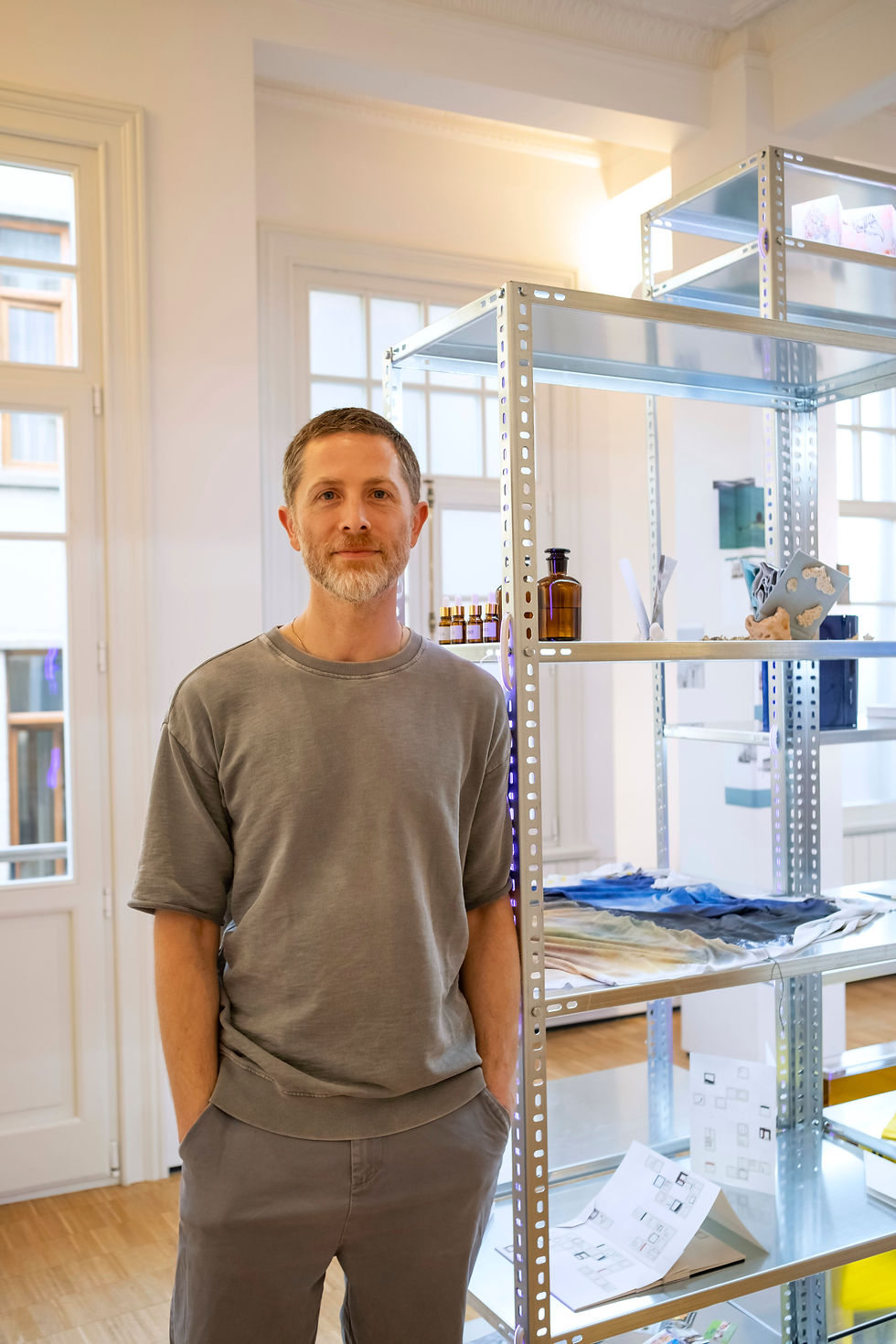
Antonia Breme, 2026. Photo: Elif Kahveci
Framing sculpture as a tactile and grounding form of resistance against our fast-paced and increasingly digitalized consumer culture, Antonia Breme investigates the commercial exploitation of human perception. As one of the artists featured in Vanilla, Grass, Almond, curated by Huo Rf, which brought together 24 artists at Kendi Collection in Istanbul, Breme deconstructs the artificial construction of desire and value through her spatial interventions and artist books. In this conversation, where the fragile materiality behind the illusions created by shop windows is revealed in its most stripped-down form, the artist reflects on the socio-economic infrastructures of our everyday lives and the significance of “being there” in person.
Antonia Breme, Fluidity Unwrapped. Photo: Barış Özçetin
You describe your sculptural practice as a form of thinking and expression. At a time when our everyday experiences are becoming increasingly digitalized and accelerated, how does working with materials and thinking through spatial forms position you?
Working with materials is a fundamental part of my sculptural process and the development of my ideas. I like to describe it as a process of “thinking with materials.” While physically engaging with materials, I try to pay attention to how my perception changes. My ideas take shape through this process, which directly informs my sculptural works. This process-oriented and often physical way of working gives me a sense of stability and grounding in a rapidly changing, increasingly digitalized world where our attention is constantly being challenged. Working with my own hands, and often within the limits of my own physical strength, creates a moment shaped around my perception, in which I can be fully present with my entire physical being. This state of “being there” offers a moment of concentration that allows me to ask sculptural questions and explore the conditions of a space. While physically moving through a space and positioning objects (whether in my studio or during the installation of an exhibition), I see myself creating networks in which the different elements of my works enter into dialogue with one another and, hopefully, with the viewer as well. At the same time, this practice-based approach allows me to translate my ideas quite directly into physical and spatial forms. Of course, this also gives me a certain sense of freedom.
Your works engage with the ways in which our perception is studied and often exploited by commercial interests. As an artist who creates physical experiences, how do you navigate the fine line between capturing the viewer’s attention to create a profound sculptural encounter and reproducing the manipulative mechanisms of the consumer culture you critique?
In advertising culture, perception is often studied in order to capture our attention within an overstimulated environment and direct it towards a commercial product. This usually happens through marketing strategies based on the dynamics of our sensory perception. My works also focus on perception, but my aim is to redirect attention towards perception itself. In doing so, I make use of methods and tools associated with consumer culture, such as the selection and use of materials, decorative elements and display arrangements. I do think I am navigating a fine line here, one that I constantly find challenging, but also an inspiring field of tension. It is precisely this point that holds the potential to create sculptural experiences that allow us to reflect on the mechanisms we are exposed to and on consumer culture itself.
This field of tension became particularly visible in my exhibition Fluidity Unwrapped, which opened at Viable in Istanbul in September 2023. Since the exhibition space and context was a former shop window located in İttihad and Sigortalar Pasajı in Cihangir, I worked with advertising elements such as rotating display panels. I stripped everything off these panels and removed the advertising images, replacing them with shiny aluminium foil from a chocolate wrapper so that it could reflect the light and its surroundings as it rotated. Another panel moved gently up and down. In this way, while trying to draw the viewer’s attention, I played with different ways of capturing their gaze.
The dynamics I refer to here relate to a marketing strategy that stimulates attention through our sensory perception, moving between what is described as “top-down” focused/goal-directed attention and “bottom-up” passive/stimulus-driven attention. However, since I am not applying a strategy, we can speak of a truly sensory experience. This experience takes shape through formal advertising elements that usually operate in the background, whereas in this exhibition they were made visible by being dismantled down to their smallest components, including their motors and cables.
Therefore, my aim is to create a multilayered and sensory experience that challenges our perception, while also creating a space to reflect on what is being displayed and the mechanisms of consumer culture.
Antonia Breme, Shop Window Shopping
Your practice intersects with certain aspects of design processes. It reveals how attributed desire and value are artificially constructed through modes of presentation, as seen in your artist book Shop Window Shopping. Do you think this modern and continuous construction of desire is an attempt to fill a deeper human void? How can art shed light on such constructions without falling into the trap of becoming another object of desire itself?
We could say that I often draw on design processes within my practice. I find the perspective of design, particularly within the context of commercial display, enriching for my artistic practice and a source of various insights. It is also important for taking a closer look at the authenticity of an object. What particularly interests me here are the constructions and systems that carry a certain functionality and contribute to the production of value and desire through modes of presentation.
Based on my sculptural perspective, which also includes my experience with window dressing, I investigate strategies and techniques for producing sensuality, desire and emotion. This research is also reflected in my artist book Shop Window Shopping. In this book, I present my sculptures and installations alongside photographs selected from my personal archive and historical trade magazines for window dressers. I also draw on my master’s thesis research, in which I focus on details and attempt to reveal the fragile materiality behind the illusion created by shop windows.
In fact, the construction of our desires through marketing strategies also aims to satisfy these desires and to fill a void that is possibly constructed itself. Although these experiences may be as fleeting as our reflection in a shop window, I believe that, in contrast, an artwork has the potential to offer a deeper experience and a more comprehensive reality.
By taking strategies of desire construction specific to commercial display contexts and integrating and/or transforming them within my artistic practice, I aim to create works that make qualities such as fragility, tension and softness tangible. Works that go beyond being objects of desire, that refer back to their own essence, and that deepen through their construction and my relationship with the material; works that open themselves up to sculptural and sensory experiences.
Antonia Breme, Fluidity Unwrapped, Exhibition view, 2023, YAYA/Viable Istanbul. Photo: Zeynep Fırat
Your participation in the cultural exchange programme at Depo in Istanbul and your exhibition Fluidity Unwrapped at Viable point to a practice that moves between different cultural and socio-economic contexts. How has moving between Berlin and Istanbul influenced the way your practice engages with and positions itself within the local?
When I was invited to have an exhibition in Istanbul in 2023 by curator T. Melis Golar and Eline Tsvetkova and Kerim Zapsu, who run Viable, I can say that a dream came true. I was very happy to return to this city by the Bosphorus, which I had previously had the opportunity to visit several times and where I had worked and exhibited. Beyond that, Viable’s exhibition space and context offered a very fitting opportunity to present my works.
As a result, Fluidity Unwrapped became an important exhibition that sharpened my artistic vision and paved the way for future projects, eventually leading to my stay in Istanbul in 2025 as part of the cultural exchange programme organized in collaboration with the Berlin Senate and Depo.
During both of my visits, my intention was to immerse myself in the city and try to build a relationship with my surroundings. Being among Istanbul’s streets, the people who live, move and work in this city, and the various materials and infrastructures that shape its urban fabric became an enriching experience for me in many different ways.
During my most recent visit, my research focused on infrastructures in public space. These infrastructures, shaped by socio-economic conditions in terms of function, material and form, appear everywhere across Istanbul, from its streets to its markets. Their purpose is to enable vendors to display their products. Although they sometimes vary, many of them resemble stairs. Each one almost becomes an indication of its owner’s flexibility, adaptability and relationship with material and space. I interpret this as a form of resilience. With the support of Usta Sercan, I produced two modular sculptures that refer to these types of display structures on an abstract level.
Later, together with Selin Ünsel, I reassembled these modular sculptures on the rooftop of my studio apartment against the view of Istanbul and the Bosphorus, examining their materials and forms, their relationship with the space, testing their flexibility and trying to understand the possibilities embedded within their forms.
Coming from Berlin to Istanbul and being able to spend time in this city has definitely had an impact on my artistic practice. I see this influence most clearly in the process of trying to adapt to this place and situate my practice within its context. I also see its effect on the way I engage with what is happening immediately around us and with local dynamics. Of course, it is also possible to say that this is nourished by the social context shaped by spaces such as Viable and Depo.
I believe that in my project Fluidity Unwrapped, I also addressed socio-political dynamics by working with an exhibition space that was accessible to everyone in the public sphere. This kind of space strives towards the democratization of experiencing art, as well as participation in social and cultural life.
Beyond the physical exhibition space, you also extend the concepts you work with into artist books. These books were also part of the exhibition Vanilla, Grass, Almond at Kendi Collection. If we consider the book as a medium, and agree that it is a more intimate and enduring form of presentation that viewers can experience at their own pace, how do you think it complements your sculptural installations? Could we say that these books invite a different rhythm of engagement with your ideas?
Working with the artist book as a medium is part of my artistic research. Through this medium, I create a space to reflect on my practice on a different level and at a different pace. When working on an artist book, I try to create arrangements between images, text and space that reveal new layers of my work and hopefully make them accessible to the viewer.
The artist book is indeed a more enduring form of presentation and continues to exist as an independent work. I would even say that it offers a rich and multilayered world in itself, one that can be revisited at any moment. For instance, the creation process of my artist book Shop Window Shopping extended over a long period of time and also carries traces of my process-based approach. In this way, I believe that it offers comprehensive insight into my artistic research and its context, while also allowing for new discoveries.
My artist book Fluidity Unwrapped, which was presented in the exhibition at Kendi Collection, refers to my 2023 exhibition at Viable but does not function merely as documentation; it also reinterprets the conceptual framework of the exhibition through the form and arrangement of the book itself. It is possible to say that this is also reflected in the way the book is presented. Through this, I aimed to create a space that encourages reflection on the construction of desire and commercial mechanisms. While referencing the exhibition, this space also allows new autonomous layers to emerge through its own structure and form.


Yorumlar