

The ghosts of memory

Sandra del Pilar’s solo exhibition Gaps and Ghosts is on view at Zilberman Istanbul from December 11, 2025, to January 31, 2026. We spoke with the artist about the exhibition, which brings historical gaps, suppressed narratives, and structures of power into focus
Interview: Selin Çiftci
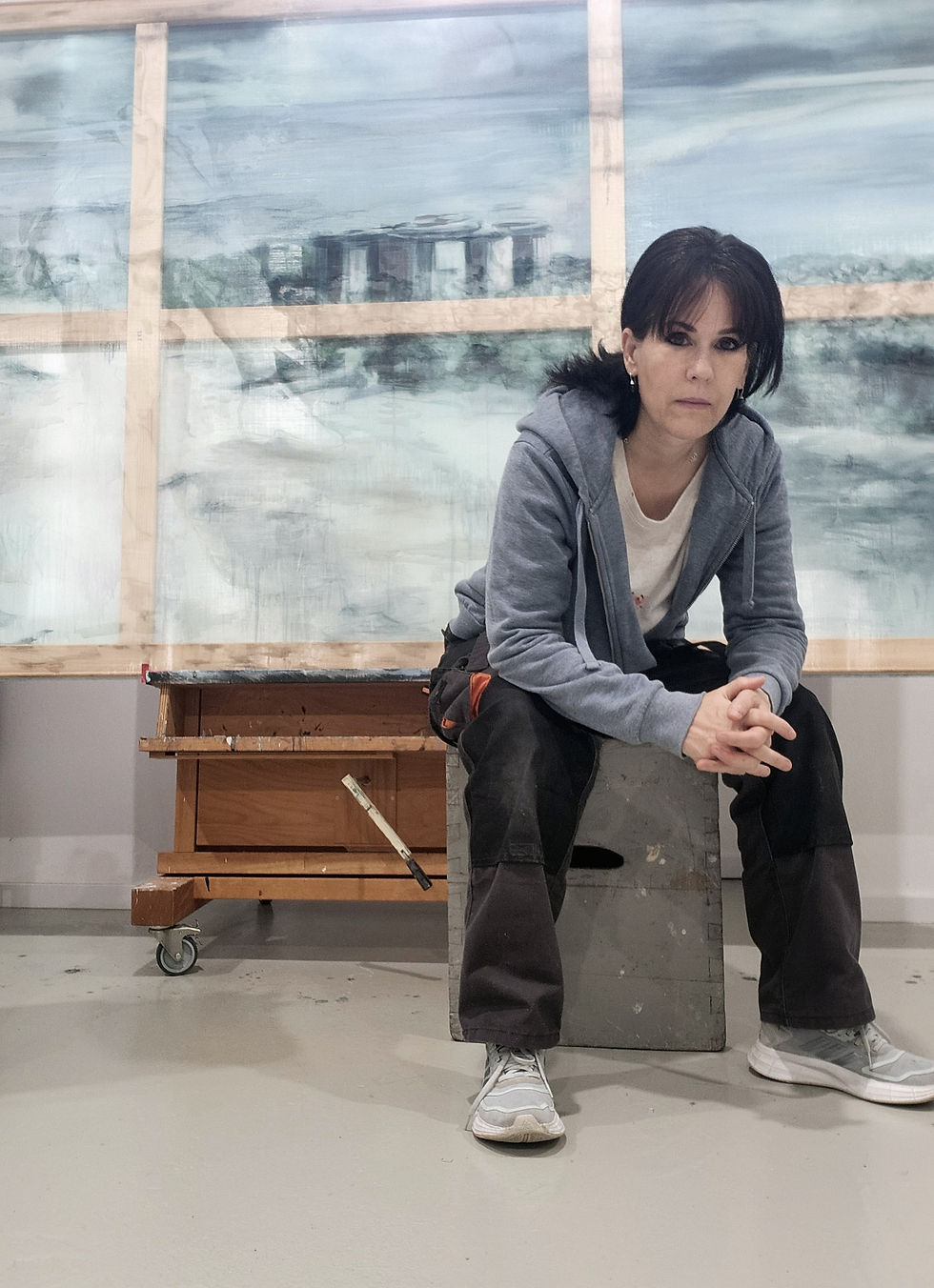
Sandra del Pilar, 2025. Photo: Thomas Oyen
Your exhibition Gaps and Ghosts consists of five separate sections. How did you construct the conceptual map that flows from the Manet reference in the first section to Malintzin in the last? Is this map linear, or is it a layered structure, much like your works, where meanings are built upon one another?
The conceptual map of Gaps and Ghosts is not linear. It is layered, recursive, and porous. The movement from Manet to Malintzin does not describe progress or chronology, but resonance. Images, histories, and bodies return in altered forms, and are built through superimposition, like in my paintings: Meaning emerges through overlap rather than sequence.
The concept of hauntology suggests that the past never truly disappears; it haunts our present like a ghost. By nature, a ghost is a figure from the past that persists in the present. In your view, what causes an image to transform into a ghost, and do these ghosts possess the power to reshape the present?
An image becomes a ghost when it has been violently simplified, silenced, or detached from its political consequences. Ghosts are not only remnants of the past; they are unresolved presences. They appear when something has been excluded from official memory. Yes, I believe ghosts can reshape the present, because they disturb dominant narratives and force us to confront what has been disavowed.
What makes a ghost “restless” for you: The act of being ignored, or the fact that justice has not yet been served?
For me, a ghost becomes restless when injustice persists. Being ignored is painful, but it is the lack of accountability, the absence of repair, that gives a ghost its urgency. A ghost is a demand, not a metaphor. It insists on being addressed.
In your approach to Manet's The Execution of Emperor Maximilian, you treat the painting not merely as an art object but as “evidence” or a “crime scene”. Where does the concept of “testimony”, often used by disciplines like Forensic Architecture, fit into your relationship with paint and layers?
In approaching Manet’s The Execution of Emperor Maximilian, I see the painting as a site of evidence rather than a neutral aesthetic object. Testimony, in my work, is not literal but material. Layers of paint function like sedimented statements, each one partially covering, partially revealing. Similar to practices such as those of Forensic Architecture, I am interested in images not as illustrations, but as carriers of testimony.However, while Forensic Architecture often reconstructs events through data, spatial analysis, and digital modelling, my medium is painting. My layers of paint function like deposits of time: each layer is a statement, a trace, a partial concealment. Testimony, for me, is not only about factual reconstruction alone, but about acknowledging that images themselves are implicated. Painting becomes a forensic act not because it proves, but because it insists on looking closely, on staying with what is uncomfortable, unresolved, and politically charged.
From left to right:
Sandra Del Pilar, En la montaña del Príncipe Pío, Madrid, From Remainings series, Oil on canvas and transparent fabric, 103x150 cm, 2025
Sandra Del Pilar, En Gallipolli, From Remainings series, Oil on canvas and transparent fabric, 155x295 cm, 2025
Sandra Del Pilar, En el cerro de las campanas, Querétaro, From Remainings series, Oil on canvas and transparent fabric, 157x194 cm, 2025
Using Saidiya Hartman’s concept of “critical fabulation”, you fill in the gaps of women’s stories in the archives with your imagination. At this point, can art be considered the legitimate form of testimony to bridge the historical gaps where official documents fail or lie?
Saidiya Hartman’s concept of critical fabulation has been fundamental for my thinking. Hartman proposes imagination is not fiction but an ethical tool or strategy. It allows us to approach histories that were never meant to be fully recorded, especially those of women, Indigenous figures, the colonized, and those without institutional power, that appear in historical records only as fragments, if at all, as La Malinche.In this context, art can indeed function as a legitimate form of testimony. Not because it replaces historical research, but because it operates precisely where documents fail, distort, or lie. Through painting, I can speculate responsibly, remaining aware of the limits of knowledge while refusing silence. Art does not claim to tell “the truth” of history, but it can expose the violence of its omissions and insist on the presence of those who were never meant to be remembered.
Museums are defined not only by what they display but also by what they choose to conceal. Is the “Gaps” in your exhibition title a reference to the silenced histories within museum archives? Do you believe today’s museum policies are ready to release these ghosts?
The gaps in the exhibition title refer to those silent zones within museum archives, to what is withheld, ignored, or deemed unshowable. Museums are shaped as much by absence as by presence. That said, I do believe that many museums today are on the right path. There is a growing awareness of responsibility, complexity, and the need for institutional self-critique.Still, we have a long way to go. Releasing these ghosts cannot be achieved through isolated gestures. It requires sustained, careful, and collaborative work among all cultural actors, artists, curators, historians, educators, and communities.
Sandra Del Pilar, Memorias de mañana (Archive for an Imagined Future), Hand-coloured lithograph, 9 pieces, Each 39x46 cm, 2025
You define maps not as mere borders, but as “structures of power.” In geopolitical debates over regions like the Arctic Ocean or Greenland, how does the “fragility” and “ghostly presence” of the Nahuatl language create a space of resistance against the rigid, legalistic language of state claims?
In my project Memories of Tomorrow / Memorias de mañana, I approach maps not as neutral depictions of territory, but as temporal instruments of power. The project operates through a chiasmus of time: past and future cross each other, destabilizing the authority of the present. By juxtaposing historical cartographies with speculative futures, the maps reveal how geopolitical claims are always constructed retroactively, through the selective activation of history in order to legitimize power in the now.
Set against the rigid, legalistic language of contemporary state claims, such as those surrounding the Arctic, Greenland, or acts of symbolic renaming, the Nahuatl language appears as fragile, embodied, and persistent. Its ghostly presence resists ownership. It does not claim territory; it remembers it. Nahuatl functions here as a subversive archive: a living record embedded in place names, rhythms, and sounds, one that resists erasure precisely because it cannot be fully institutionalized. This form of resistance is not confrontational but durational, exposing how every territorial claim is haunted by earlier, unresolved histories.
The starting point of Memories of Tomorrow was Donald Trump’s proposal to rename the Gulf of Mexico as the “Gulf of America.” This gesture made visible how language itself operates as a geopolitical instrument. In response, I studied Juan Blaeu’s atlas from 1665 in Oaxaca, where the body of water is clearly labeled Golfo de México. Later, in 2025, the Mexican president Claudia Sheinbaum offered an ironic counterpoint: if one insists on historical arguments, then much of North America could just as well be called America Mexicana. To this day, the United States is marked by countless Spanish place names that testify to Mexican histories, while in Mexico a vast number of place names are rooted in Nahuatl, indeed, even the name “Mexico” itself emerges from this language.
Within this project, language becomes a form of historical sediment: a subversive archive that survives conquest, borders, and renaming. In the face of renewed U.S. geopolitical ambitions, these linguistic traces are reactivated, not as nostalgia, but as quiet, persistent reminders that power can rename territory, but it cannot fully erase memory.
What are your thoughts on today's migration and border policies?
Seen from this perspective, contemporary migration and border policies appear even more contradictory. Borders claim to be fixed, while language and memory reveal centuries of movement, exchange, and entanglement. Migration is not an exception to history; it is a human condition.The attempt to harden borders today, both physically and rhetorically, ignores the deep linguistic and cultural archives that undermine any idea of purity or ownership. Policies that criminalize movement are ultimately attempts to silence these histories. They fail because the ghosts of language, place names, and memory continue to cross borders regardless.
Sandra Del Pilar, Soldan sağa Se quebró el cántaro, Corrección, Por qué?, From Disasters series, Oil on canvas and transparent fabric, Each 185x185 cm, 2025
As an artist working across two distinct geographies, Mexico and Germany, how do you bridge the gap between Germany’s cold, systematic archives and Mexico’s clay-like, earthy, and mythological memory?
Germany and Mexico represent two very different modes of memory for me. Germany works through systems, archives, and classifications. Mexico carries memory in the body, in earth, clay, myth, and oral tradition. My work exists in the tension between these two logics. Painting becomes a bridge where archive and soil meet, especially because it is not only a visual, but a bodily medium: Paint has weight. It has a smell, texture, and resistance. It demands time and physical engagement. As one of the oldest human cultural techniques, painting connects the archival impulse with something pre-verbal and tactile. In my work, the “coldness” of the archive meets the “warmth” of matter. History is not only seen, it is felt.
Sandra Del Pilar, From left to right El sueño de la razón produce monstruos, Y aún no se van, Ya tienen asiento, From Disasters series, Oil on canvas and transparent fabric, Each 185x185 cm, 2025
In the section Caught in Disasters, you reinterpreted the naked male figures you created twenty years ago as the “collapse” of masculine myths, heroism, and power. How has your narrative of “masculinity” evolved from then to today?
When I first created the naked male figures in Caught in Disasters, masculinity was still closely tied to ideals of strength, control, and heroism. Today, those same bodies read as fragile, exposed, and on the verge of collapse. This shift is not only historical, but deeply political: masculinity has lost its claim to inevitability.This is especially important to remember at a moment when rising autocracies, ongoing crises, and wars suggest a return to rigid, violent forms of masculinity and power. The achievements of the last two decades, anti-colonial thought, anti-racism, feminism, inclusion are fragile; they can easily be overwritten and thus erased. Losing them would be devastating for the future.Through the painted veil-like layers, the exposed bodies are emphasized in their vulnerability as a political position. These layers do not protect; they reveal. They resist the re-masculinization of power we are currently witnessing by insisting on fragility, permeability, and doubt.
Did you discover a ghostly space in Istanbul? Did you see traces of your works in the city's architecture or crowds?
Istanbul, like Mexico City, is full of ghostly spaces. Both cities hold multiple temporalities at once: empires, ruins, crowds, and constant motion coexist without being resolved. In Istanbul’s architecture and density, I encountered something deeply familiar: a refusal of singular narratives.One example was the layered presence of Hagia Sophia, where religious, imperial, and secular histories overlap without canceling each other out. Another was the continuous movement along the Bosphorus, ferries crossing back and forth, carrying people between continents as if borders were provisional rather than absolute.In both instances, I recognized parallels not only to Mexico, but also to my own work: the coexistence of contradictions, the acceptance of unresolved histories, and the understanding of ghosts not as remnants of the past, but as active agents in the present.
Istanbul does not erase its ghosts; it lives with them.


Yorumlar