

SAHA Studio 10th Term projects
SAHA Studio presented new works by Can Memişoğulları, Gizem Ünlü, Mk Yurttaş, Neval Tarım, and Suat Öğüt, produced during their residency at its İMÇ space between July and December 2025, to the public from 24 to 27 December 2025. We spoke with the artists about the projects they developed throughout the residency period
Dosier: Berfin Küçükaçar

SAHA Studio
Can Memişoğulları
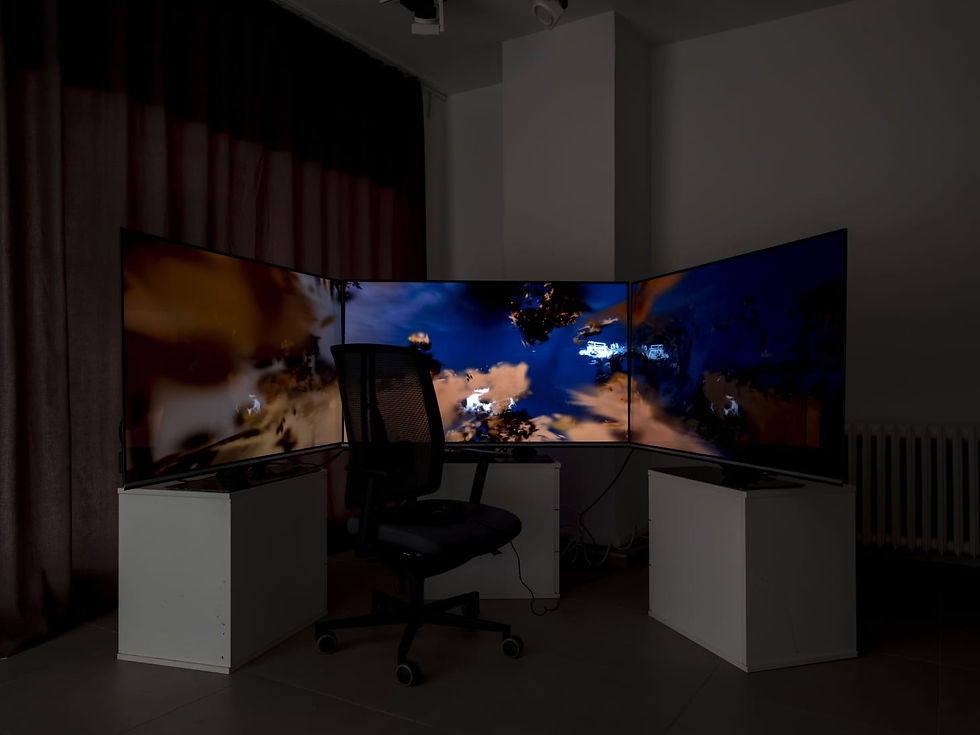
The work by Can Memişoğulları presented as part of SAHA Studio’s 10th End of Term exhibition
During your field research around İMÇ throughout the SAHA Studio period, everyday encounters with objects, sounds, and spatial details opened up ways of thinking about the bazaar’s historical and contemporary layers together. In your projects Strategies of Survival of Things and Ghosts of İMÇ, how did these encounters and moments of listening shape the direction of your work? While moving through İMÇ, what kinds of questions or modes of production, ones you had not initially anticipated, emerged for you through the sounds, stories, and objects you encountered?

Strategies of Survival of Things emerged from an attempt to understand space through the object relations that arise in order to survive within İMÇ. Small things I encountered during everyday movement through the building gradually began to shape the direction of the work. For example, the contrast between simply collecting air conditioner runoff as a gesture that can generate a form of public interaction, and the same action taking place in front of someone else’s shop window, behind closed doors. These moments seemed to say a great deal about İMÇ as it exists today. Similarly, details such as the electronic components of what was likely once a studio speaker being dismantled and repurposed as a parking bollard made visible the survival strategies through which İMÇ has acquired new functions over time, from its past into the present.
When I began to think about these strategies in relation to their historical context, an entirely different layer opened up. We all know that İMÇ Block 6, Unkapanı, was one of the most important music hubs in Türkiye from the 1970s through the early 2000s. People would come here from villages across Anatolia, selling their homes, their land, even their tractors, in the hope of being discovered and releasing a cassette. According to producers from that period, anyone who looked even slightly well dressed or resembled a producer would be approached and sung to. In other words, these corridors were once filled, throughout the day, with people trying to exist by singing to someone.
This led me to a simple question: if those voices, the ones that never made it, or that have since disappeared, were still circulating through the walls, what would they sound like? Ghosts of İMÇ emerged precisely from this question. In a way, both the everyday encounters and these narratives, these moments of listening, became the elements that set the direction for me in both projects.
Gizem Ünlü

The work by Mk Yurttaş presented as part of SAHA Studio’s 10th End of Term exhibition
Your observations and field research in the Unkapanı area focus on the sense of visual density and pressure produced in everyday life by shop windows, signage, and modes of display. In this work, what kinds of thresholds did your relationship with the visual environment you encountered in Unkapanı make visible for you? How do these thresholds generate a field of tension in the encounter with the viewer?

I have been spending a long time in Unkapanı. Shop windows, signs, and display practices produce a language and a discourse through the images, words, and objects they make visible and circulate. This is not only about what is shown, but also about how it is shown and with what degree of intensity. Fantasies of power and desire enter circulation together with everyday objects.
Of course, this is not specific to this area alone; it is closely tied to the atmosphere of our time. It is simply felt more intensely in this particular environment.
In my studio work, today’s landscape and the sense of compression produced by this suffocating atmosphere take form not through a linear narrative, but through a fragmented, discontinuous, and deliberately unfinished structure. The works that emerge do not aim to tell a single story or present the outcome of a research process. For this reason, I think visitors to the studio remain within a field of encounter in which they cannot fully name what they are looking at. Objects, surfaces, and gestures do not produce fixed meanings.
Along with this sense of uncertainty, the works carry a feeling of compression and inescapability that operates through repetition. The tension is experienced through the body and the gaze, across the surfaces of the space.
Mk Yurttaş
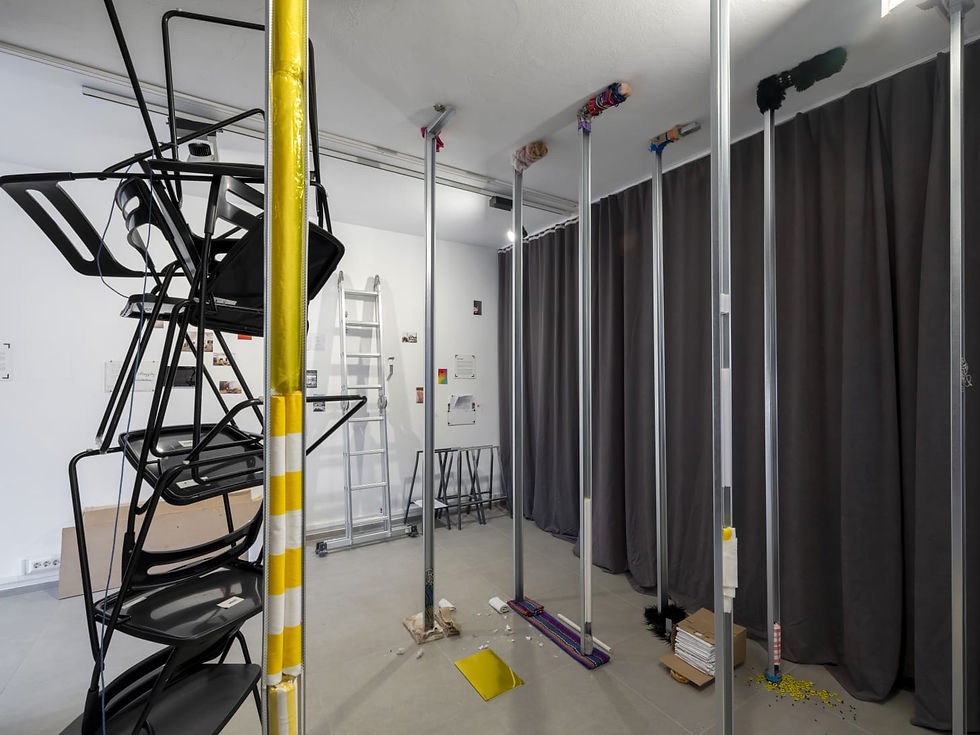
The work by Mk Yurttaş presented as part of SAHA Studio’s 10th End of Term exhibition
While the project you developed within SAHA Studio engages with a broad body of material drawn from projects previously supported by SAHA, it also constructs a new narrative around performance, the body, and more-than-human thinking. As you began working with this material, what did the project itself start to reveal to you? Over time, which trajectories, repetitions, or deviations came to the fore, and how did they shape the work into its current form?

When I began working with this material, what it first communicated to me was not a call to construct a narrative, but rather a density that resists narrativization. I approached SAHA’s activity reports not as an archive, but as an unprocessed database. This database did not propose a linear reading or a coherent story. Instead, it opened up the distributed traces left over the years by performance, the body, and posthuman thought as overlapping fields of potential. For this reason, from the very beginning the project took shape not around the idea of producing a new narrative, but around creating a living field of witnessing.
Over time, the trajectories that came to the fore emerged through the repetitions and shifts within the database itself. In particular, the forms of collectivity that appear in the public space performances of Aslı Çavuşoğlu and Ahmet Öğüt suggested that “performance” expands into modes of coming together, negotiation, and thinking collectively. This expansion, in turn, opened up a way of considering the body not as a singular and central subject, but as a becoming that is constantly negotiating with its surroundings. Similarly, the interspecies spaces of negotiation that stand out in the projects of Elmas Deniz and Burcu Yağcıoğlu created a ground closely aligned with the relationships I was forming with objects and space during the studio process. Deniz Gül’s performative experiments with furniture, and Zeynep Kayan’s practice centered on a chair, prompted me to reflect on how everyday, already existing objects can become active agents. Leman Darıcıoğlu’s approach, which displaces the body and material from normative assumptions, also circulated in the background as an important reference throughout this process.
In this process, deviations were just as decisive as repetitions. The recurring need to occasionally empty the studio, the emergence of imbalance and the possibility of falling not as problems but as productive conditions, and the way objects, together with the studio’s own material qualities, began to steer the performative process all continuously shifted the direction of the work. It was precisely at this point that the concept of metastability returned as a way of thinking this state that is neither fixed nor chaotic, but provisional and yet operative.
At the point UNVEIL has reached today, the project exists for me not as a representable or fixable outcome, but as a posthuman mode of practice that investigates ever-shifting potentials of “vibrant matter.” A field opens up in which the boundaries between human, object, and environment are suspended, and in which agency is not concentrated in a single body but distributed across objects, space, gravity, weather conditions, and chance. What emerges, therefore, is not a narrative over which the viewer can claim full command, but an experience that takes shape differently in each encounter, inevitably and willingly allowing certain details to slip away, and operating precisely through this incompleteness. This long-term engagement with SAHA’s database led me to think of the work as a practice that remains in continuous negotiation rather than as a linear process of production. Each arrangement, dispersal, and reassembly that took place in the studio became less an act of producing a “work” than an experiment in thinking with conditions. In this sense, UNVEIL continues to exist not as a closed project or a completed form, but as a process that can be reopened in different contexts and multiplied through other bodies and agents.
Neval Tarım

The work by Neval Tarım presented as part of SAHA Studio’s 10th End of Term exhibition
In Ash Diaries, family narratives, testimonies, and environmental sounds related to the Tahir Paşa Mansion come together to form a dense and fragmented memory of place. How did working with layers of memory that sometimes overlap and sometimes diverge shape your process of production? In this project, how did sound become both a personal mode of remembering and a shared ground that opens space for the narratives of others?

Working with different memories in Ash Diaries required me to continually reposition my process of making. Narratives about the Tahir Paşa Mansion often converged around the places that people remembered most vividly, while the details attached to those places sometimes aligned, sometimes diversified, and at times directly contradicted one another. Spaces such as the staircase, the bathroom, the basement, or the garden appeared repeatedly in these accounts, yet these repetitions did not point to a single spatial reality. Instead, they revealed how the mansion took on different forms for different people. These overlaps and divergences prevented me from approaching the mansion as a fixed architectural entity. Rather, I followed which spaces memory intensified, which details it magnified, and which points it left indeterminate. The gaps, hesitations, and inconsistencies within the narratives guided the production process. Instead of attempting to complete the space, I chose to make these fragile modes of remembering visible.
Throughout this process, I continually questioned how accurately I was perceiving the narratives. While conducting the interviews and working with them afterwards, I proceeded with an awareness that what I was listening to was not limited to what was being said. In interviews with family members and people I already knew, my perception inevitably shifted; subtle changes in facial expressions, breaks in tone, and moments of hesitation carried far greater significance for me. This awareness led me, rather than fixing the narratives in place, to develop a mode of listening that remained both attentive and deliberately distanced.
I also structured the physical units of the sound installation and the sound compositions within them through these modes of remembering and forgetting. Spaces that remained strongly present in memory became more pronounced and dense modules within the exhibition space, while areas that appeared ambiguous or contradictory in the narratives were translated into a more fragmented, transitional, and indeterminate sensory structure. In this way, the installation evolved into a configuration that traces the shifting relationships between spaces that come to the fore in memory, rather than reproducing the architectural plan of the house.
In this project, sound initially emerged for me as a personal mode of remembering, a carrier of my childhood memories, my indirect relationship with the site, and my curiosity toward a lost structure. I never saw the Tahir Paşa Mansion in its entirety. Because the wooden building had completely burned down, I later realized that, as a child, I had only played among its stone foundations and remaining walls. I recalled this detail after the project had already begun. At the time, the site felt to me and to my peers like one of those vacant, slightly frightening “haunted house” lots found in many neighborhoods. The fact that not the mansion itself, but only its stone remnants remained made the place feel even more uncanny and charged the imagination all the more. For this reason, from the outset sound was connected less to a concrete memory than to a sense of space that was incomplete and fragmented. As the production process progressed, I did not want to use sound solely as a means of expressing my own memory. Its ambiguous, temporal, and permeable nature offered a powerful shared ground for opening space to the narratives of others. Since the original building no longer exists, I searched for the sounds of the mansion across other sites, surfaces, and materials. This search transformed sound, for me, from a representational device into an active research practice that traces the presence of a lost architecture. The same sound could evoke a personal association for me, while at the same time generating new layers of meaning through the narratives of others.
Throughout this process, I hoped that sound would not only carry the narratives, but also open up space for the listener. I wanted the installation to become an experience in which viewers could activate their own memories, spatial associations, and imaginaries. In Ash Diaries, sound exists less as a record that fixes the past than as an open and living field in which my memory, the narrators’ memories, and the listeners’ memories intersect.
Suat Öğüt

The work by Suat Öğüt presented as part of SAHA Studio’s 10th End of Term exhibition
In Echo of Silent Roars, developed within SAHA Studio, traces left behind by protest movements are transformed into a layered spatial configuration shaped around questions of property and inheritance. Working with slogans, surfaces, and routes carried from the past into the present, what kinds of questions did this process raise for you about how public space remembers? In this work, how would you describe the moments in which the relationship established with the past comes into contact with the political language of today?

In thinking through Echo of Silent Roars, I approach public space not as a passive backdrop, but as an active subject that carries, transforms, and at times suppresses memory. I focus on moments in which the sounds and echoes that remain after marches intersect with surfaces. I understand these moments as thresholds where traces slip out of their everyday context and evolve into an almost spiritual register, reminiscent of ancient cities. The slogans left behind by protests, worn surfaces, and recurring routes are not merely remnants of the past, but offer a critical lens on how property and inheritance are defined, by whom, and through which mechanisms. In this sense, public space appears to me as the site of a memory that remains under negotiation and incomplete.
While working with these traces, I am particularly interested in what is temporary and in the incidental frames through which I witness a given moment. At times, you encounter moments that require very little explanation to speak for today’s socio cultural context. I describe these as a silent scream embedded within the surface itself. These moments, in which the echoes of sounds left after marches intersect with surfaces, carry a spiritual intensity for me as well, because space begins to speak through fleeting encounters. I choose to remember public space through these temporary and momentary encounters on surfaces, and paradoxically to render it enduring through this very fragility. This approach allows me to develop a critical yet constructive stance toward official and sterilized modes of memory production.
The starting point of the project is the 1961 Saraçhane rally, one of the most extensive actions of the working class. The fact that workers, who gathered at five different points and marched toward Saraçhane, eventually assembled right at the corner of what is today SAHA Studio at İMÇ created a powerful historical intersection for me. While moving through archival material, you can still come across scenes that resonate with today’s landscapes. These historical layers, in which the sounds and echoes left behind after the marches merge with surfaces, transform Saraçhane into an almost ritualistic meeting ground. The fact that Saraçhane has once again become a gathering point under today’s conditions, a site with a deep historical past where those who now occupy minority positions seek to make their voices heard, led me to choose this area as both the starting and ending point of my research. Even though words, positions, and views may change, I believe that the roles and responsibilities assumed by society in Türkiye, and beyond that, the mental fatigue produced by persistent pressure, have not changed very much. Within this project, I tried to trace precisely this fatigue.


Yorumlar