

Manifesta 16 Ruhr: Ayzit Bostan
- Selin Çiftci
- 14 saat önce
- 2 dakikada okunur
Manifesta 16 Ruhr, organized this year under the title This is not a church opened on June 21, focusing on the region’s multi-layered socio-cultural structure and deep-rooted heritage of migration. The fifth and final guest in our interview series with Turkish artists creating site-specific works for the biennial is Ayzit Bostan
Interview: Selin Çiftci

Ayzit Bostan. Photo: Fabian Frinzel
How did Manifesta 16’s curatorial concept, This is not a church, and the layered structure of the Ruhr region influence the selection or creation of your work? What would you like to say about the dialogue you established with the curators and the process your work underwent from its initial concept to its exhibition?
During his research, curator Gürsoy Doğtaş came across my silk scarf featuring a Nazar Boncuk design, which I created in 2021 for the annual gifts of the Munich Art Association. I was deeply honored to be invited to Manifesta 16, not only because the work is being presented in a new context, but especially because I find the Thomaskirche particularly compelling: a space that is not meant to be a church, but rather a place of encounter, silence, and invisible stories. It is precisely within this tension that I wish to show my work, as a sign that not only protects, but also sees.
The Ruhr region is one of the historical centers of the wave of migration from Turkey. What does Manifesta’s geographical selection and the region’s “guest worker” legacy signify for your artistic practice or the work you conceived for this exhibition?
The Ruhr as a center of the guest worker history is for me not just a theme, it is a topic of personal experiences. My motif, the Nazar Boncuk, a symbol I have known since childhood, only became a key for me a few years ago. I rediscovered it not as memory, but as a conscious sign within the European context: an eye that sees, protects and connects. Nazar means “to see, gaze, insight”; and that is exactly what fascinates me: the power of simplicity, minimal design with maximum meaning. It brings good karma. Manifesta gives this presence space, not as memory, but as living presence.
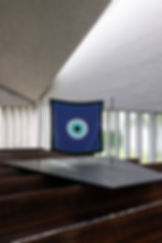
Ayzit Bostan, Silk Scarf (Nazar Eye Design), 2021. Photo: Manifesta 16 Ruhr (Ivan Erofeev)
How do you establish the “silent knowledge” of the visual language you use in your work that functions without relying on the “subtext” of a specific geography? What does the initial connection a viewer, unfamiliar with the historical context, establishes through form and material alone tell you?
For me, “silent knowledge” lies precisely in this independence: when someone sees an object without knowing where it comes from or what it means; and yet feels something: a memory, a sensuality, a visual experience, then the work has already worked. This first, intuitive connection, arising solely through form, material, and movement, tells me more than any explanation ever could. It shows me that something universal lives within the work, something that is not only in the Ruhr, but everywhere. That is exactly my aim: not just to tell, but to touch. Not just to document, but to connect. And when a viewer, unfamiliar with the historical context, feels a sense of belonging or curiosity, then I know: the concept works. It communicates without speaking.